Incremental borrowing rate under ASC 842: the hard part is doing it again next quarter
Last updated:
11 min read
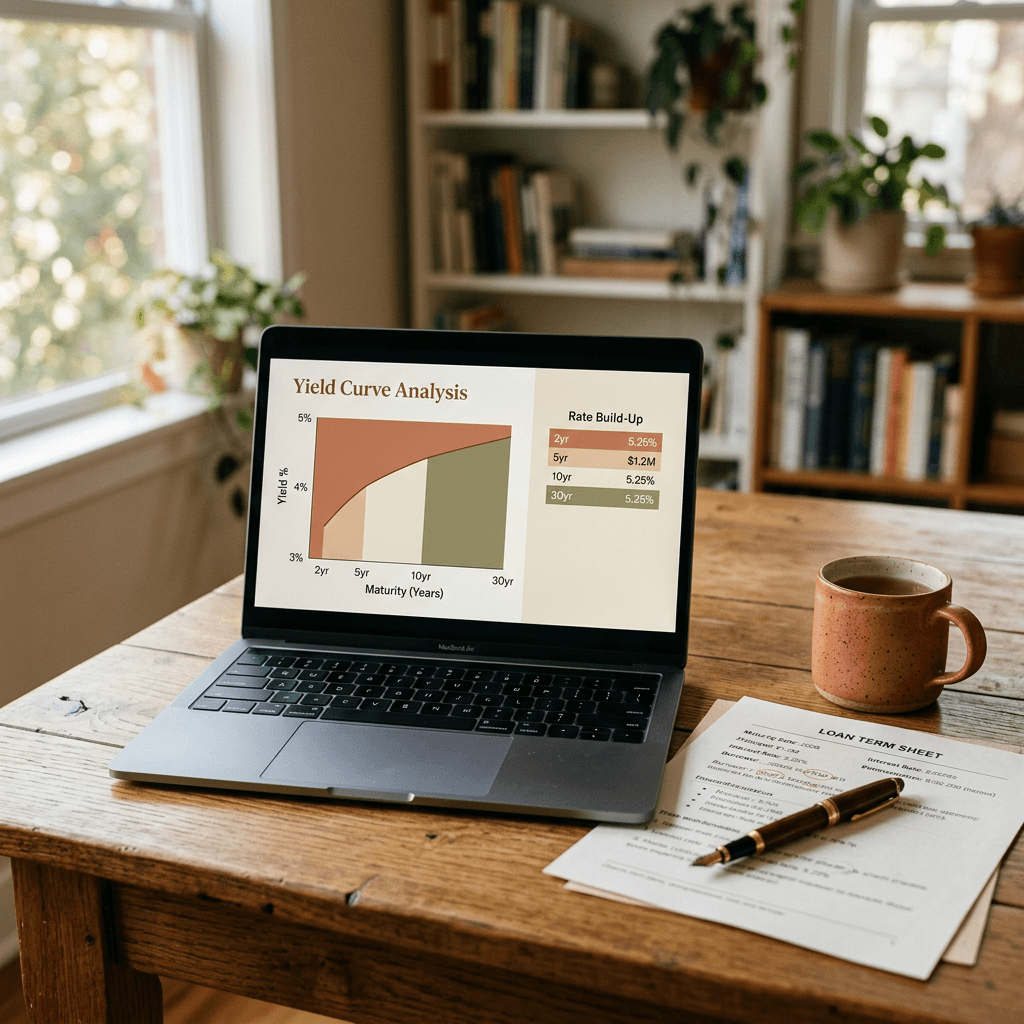
The incremental borrowing rate under ASC 842 is the rate of interest a lessee would have to pay to borrow, on a collateralized basis, over a similar term, an amount equal to the lease payments, in a similar economic environment. It is the fallback in the standard's discount rate hierarchy, used when the rate implicit in the lease is not readily determinable.
For commercial real estate, the fallback is the rule rather than the exception. Determining the implicit rate requires the asset's fair value and the residual value the lessor expects, and a landlord has no reason to hand a tenant either. So most occupiers discount most of their portfolio at an IBR, and the number they choose moves the lease liability on the balance sheet.
The hierarchy, and why the implicit rate rarely applies
ASC 842 asks a lessee to use the rate implicit in the lease if that rate is readily determinable, and the incremental borrowing rate if it is not. The order matters, and it is not optional.
Readily determinable is doing real work in that sentence. The implicit rate is the rate at which the present value of the lease payments and the unguaranteed residual value equals the fair value of the underlying asset plus the lessor's initial direct costs. A lessee would need the landlord's view of both fair value and residual, which is information a landlord treats as its own. Equipment leases from a captive finance arm sometimes disclose enough to derive it. A fifteen year retail lease almost never does.
One practical consequence worth stating plainly: concluding that the implicit rate is not readily determinable is itself a judgment that should be documented, not an assumption. Auditors ask.
What FASB found when it looked back at this
The most useful evidence on the IBR does not come from a vendor. It comes from the standard-setter's own review of how Topic 842 worked in practice.
FASB's post-implementation review roundtable materials record that "preparer and practitioner feedback indicated that it was difficult for lessees to determine the incremental borrowing rate (IBR)," that the IBR "is more closely scrutinized under the Leases standard because all leases are required to be recognized on a lessee's balance sheet," and that requiring a lessee to "determine and substantiate a secured borrowing rate involves significant costs." Then the finding that reframes the whole topic: "after implementing repeatable processes for determining the IBR when implementing the Leases standard, the costs and complexities were substantially reduced" (FASB, Post-Implementation Review of Topic 842, Leases, Public Roundtable discussion materials, September 12, 2025).
Read that carefully. The difficulty is real, and it is front-loaded. Companies that built a method, wrote it down and reused it stopped finding this expensive. Companies that treat each rate as a fresh analytical exercise are still paying for it every quarter. The IBR is a hard problem exactly once.
The four attributes that make a rate defensible
The definition contains four conditions, and an auditor will test the rate against all of them. Most errors are a rate the company already had, pressed into service without meeting any.
| Attribute | What it requires | What gets used instead | Why the substitute fails |
|---|---|---|---|
| Collateralized | A secured borrowing rate, reflecting an asset similar to the right-of-use asset | An unsecured corporate borrowing rate or a bond yield | Secured borrowing prices below unsecured, so an unsecured rate is too high, which discounts the liability below where it belongs |
| Similar term | A rate at a tenor matching the lease term determined under ASC 842 | A single entity-wide rate applied to every lease | The yield curve is not flat. A three year lease and a fifteen year lease cannot both be correctly discounted at the same rate |
| Similar amount | A rate appropriate to an amount equal to the lease payments | The rate on the revolver or the largest credit facility | Pricing on a large facility reflects size, seniority and relationship, none of which describe a single store lease |
| Similar economic environment | The currency and jurisdiction in which the asset sits | The parent's home-country rate applied across the portfolio | A lease denominated in another currency carries that currency's rate structure, and applying a domestic rate to it is a foreign exchange assumption nobody made deliberately |
How to build a rate
The build-up method is the common approach and the one easiest to substantiate, because each component has a source someone else can check.
- 01Start with a risk-free base at the matching tenor. Take the sovereign curve for the lease's currency at the lease's term, not a single benchmark tenor applied everywhere.
- 02Add a credit spread for the borrowing entity. Where the company has traded debt, use it. Where it does not, a synthetic rating derived from financial metrics, or observed spreads for comparable credits, is the usual substitute. Be consistent about which entity in the group is borrowing.
- 03Adjust for collateral. Secured borrowing prices below unsecured, and the adjustment should reflect the characteristics of the underlying right-of-use asset rather than a flat haircut applied portfolio-wide.
- 04Match currency and jurisdiction to the lease, not to the parent.
- 05Use the lease term as determined under ASC 842, including renewal options reasonably certain of exercise. The tenor follows the accounting term, not the stated term, which means the rate depends on the option assessment. Accurate lease abstraction is upstream of the discount rate for exactly this reason.
- 06Document the method, the inputs, the source and the date. Auditors test the method as much as the number. A defensible method applied consistently survives review better than a precise number nobody can reproduce.
Where it goes wrong
The recurring errors are consistent enough to list, and every one of them is a rate borrowed from elsewhere in the business.
- WACC standing in for the IBR. The weighted average cost of capital blends debt and equity. The IBR is a borrowing rate. They are different numbers measuring different things, and WACC is generally the higher of the two.
- One rate for the whole portfolio. Convenient, and indefensible the moment anyone compares a two year lease to a twenty year one.
- The revolver rate. Short, unsecured, sized for the enterprise, and priced on a banking relationship.
- No collateral adjustment at all.
- The parent's rate applied to leases in other currencies.
- The rate never updated for new commencements. A rate set at adoption in 2019 is not the rate for a lease commencing now.
- The rate not reset on remeasurement where the standard requires it. Not every remeasurement resets the discount rate, and the triggers that do are specified in the standard. A change in the lease term or in the assessment of a purchase option is the clearest case. Confirm the triggers against the standard and your accounting policy rather than resetting the rate by default or never resetting it at all. The rest of the remeasurement mechanics sit in the lease remeasurement checklist.
- No documented build-up. This is the one that turns a reasonable rate into an audit finding. "Inappropriate discount rates" appears among the findings auditors raise at quarter-end close, and an undocumented rate is inappropriate by default because nobody can test it.
The risk-free rate election, and why fewer take it than you would expect
Lessees that are not public business entities may elect to use a risk-free rate instead of an IBR. Since ASU 2021-09, that election can be made by class of underlying asset rather than entity-wide, and it is available to private company, not-for-profit and employee benefit plan lessees. The hierarchy still binds: where the rate implicit in the lease is readily determinable for an individual lease, a nonpublic lessee must use that rate rather than a risk-free rate (Journal of Accountancy, Ken Tysiac, November 2021).
The election exists because building an IBR is expensive. The reason it is used less than that would suggest is arithmetic. A risk-free rate is lower than a credit-adjusted borrowing rate, a lower discount rate produces a higher present value, and a higher present value means a larger lease liability and right-of-use asset on the balance sheet. It can also push a lease across the classification threshold that compares the present value of lease payments to the fair value of the asset, turning an operating lease into a finance lease, with the different expense pattern that follows. FASB's review records exactly this: nonpublic entities were reluctant to apply the expedient entity-wide because of higher resulting lease liabilities and potential classification changes, which is what the by-class election in ASU 2021-09 was meant to relieve.
So the trade is explicit. Take the election and save the cost of building rates, at the price of a larger balance sheet and some classification risk. Take it by class and you can confine that trade to the asset types where it does not matter. Anyone weighing it should model the classification effect first, because it is the consequence people discover late. The mechanics of that threshold sit in finance lease vs operating lease.
Entities reporting under IFRS have no equivalent expedient. IFRS 16 applies the same hierarchy, the rate implicit in the lease where it can be readily determined and the lessee's incremental borrowing rate otherwise, with no risk-free alternative, which is one of the practical divergences covered in IFRS 16 software.
The part that is actually hard
Setting one rate is a modelling exercise an experienced person can do in an afternoon. Running a portfolio is a different job, and it is the one FASB's finding points at.
A four hundred lease estate with ordinary churn produces a continuous stream of rate requirements. Every new commencement needs a rate as of its commencement date, at a tenor matching its accounting term. Every remeasurement that resets the rate needs one as of the remeasurement date. Every renewal option that becomes reasonably certain changes the term, which changes the tenor, which changes the rate. None of these arrive on a schedule, and all of them have to be evidenced individually.
A repeatable process, in the sense FASB's review means it, is a small number of decisions made once and then applied: a written method, a named curve source with a stated refresh cadence, a rule for tenor matching, a rule for which events reset the rate, a single owner, and a per-lease audit trail recording the inputs and the date. Companies that have those things find their auditors ask fewer questions every year. Companies that rebuild the logic each quarter get the same questions every time.
That is the case for holding lease terms, option assessments and discount rate inputs in one place rather than reconstructing them from a spreadsheet at each close, which is what lease accounting and the wider financial operations work is for. The standard did not make the IBR difficult. Doing it by hand, repeatedly, is what makes it difficult.
FAQ
What is the incremental borrowing rate under ASC 842?
- It is the rate of interest a lessee would have to pay to borrow, on a collateralized basis, over a similar term, an amount equal to the lease payments, in a similar economic environment. It is used to discount lease payments when the rate implicit in the lease is not readily determinable, which is the normal situation for commercial real estate because the lessee does not have the landlord's fair value and residual assumptions.
Can we use our WACC as the incremental borrowing rate?
- No. The weighted average cost of capital blends the cost of debt and the cost of equity and describes the return required on the business as a whole. The IBR is a secured borrowing rate for a specific term and amount. Using WACC is one of the most frequently raised discount rate findings, and it generally overstates the rate, which understates the lease liability.
Does the incremental borrowing rate have to be different for every lease?
- Not necessarily different for every lease, but it must vary with term, and it should reflect currency and the borrowing entity. Many companies build a rate curve and read off the tenor matching each lease's accounting term, which satisfies the term-matching requirement without pricing each lease individually. A single flat rate applied across all terms is the version that does not hold up.
When does the discount rate have to be updated?
- Not at every remeasurement. The standard specifies the circumstances that require a new discount rate, with a change in the lease term or in the assessment of a purchase option being the clearest. Because the answer depends on the triggering event and on your accounting policy, confirm the specific triggers against the standard rather than adopting a blanket rule in either direction.
Should a private company take the risk-free rate election?
- It depends on what the balance sheet effect costs. The election removes the work of building an IBR, but a risk-free rate is lower, which produces a higher lease liability and right-of-use asset and can flip an operating lease to a finance lease. Since ASU 2021-09 the election can be made by class of underlying asset, so the sensible approach is to model the liability and classification impact by class and elect only where the effect is acceptable.
More From Our Blog
More
Closing under ASC 842 without quarter-end surprises
Where lease accounting breaks down at scale, and how to keep every figure traceable to the clause behind it.

A remeasurement checklist for changing leases
The events that trigger a remeasurement, and how to post each one without breaking the audit trail.

What IFRS 16 software needs to do, and why a spreadsheet stops being enough
IFRS 16 puts nearly every lease on the balance sheet under one model. The software that handles it well earns trust on remeasurement, not day one.

Initial agents live in two weeks.
Start with one or two high-value workflows, connect the required data and documents, measure the result, then expand across domains.
- A tailored onboarding for every enterprise.
- Fitted to how you actually work.
- Continuous support as your portfolio evolves.