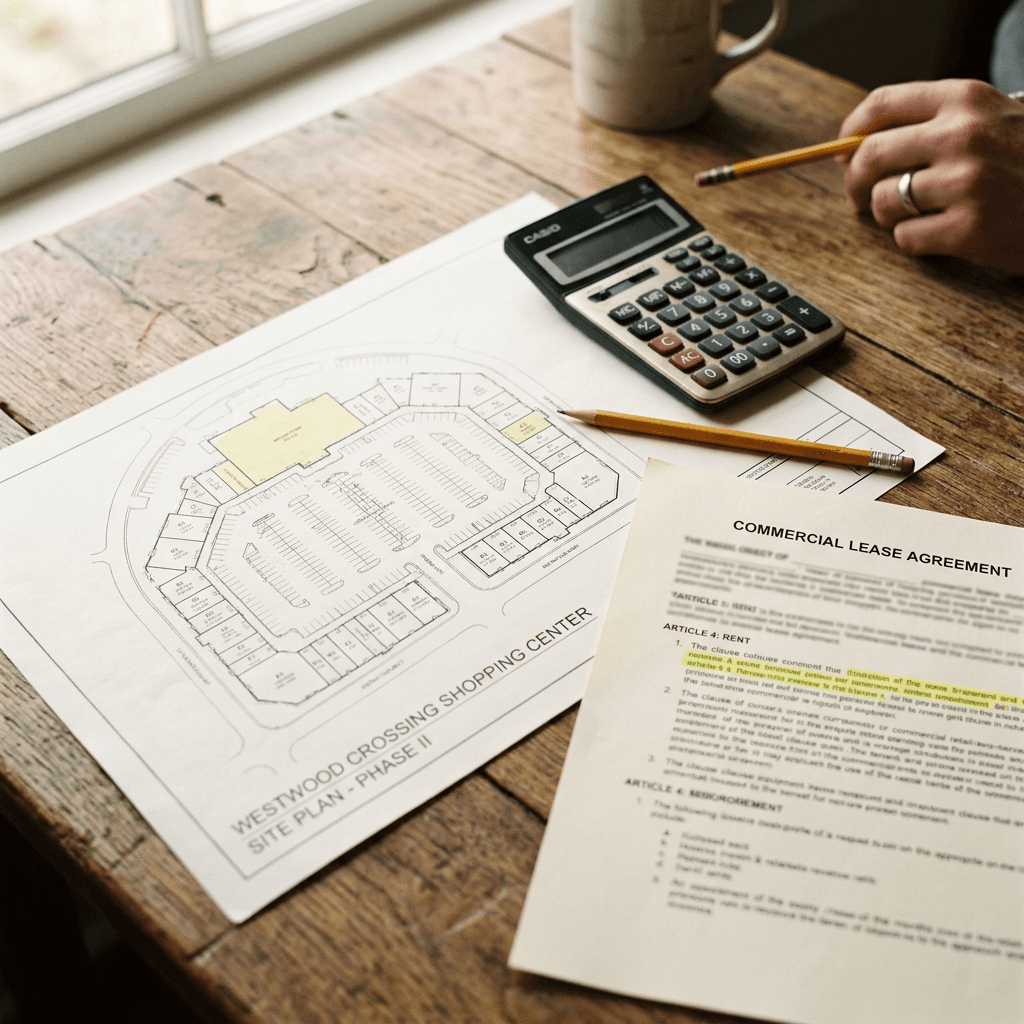
Pro rata share is the proportion of a property's shared costs that a tenant is responsible for, expressed as a percentage. It is calculated by dividing the area of your premises by a defined total area for the property, then applying that percentage to the shared cost pool: common area maintenance, property taxes, insurance, or all three.
The arithmetic is not the hard part. The definitions inside it are, and they are negotiated rather than given.
The formula is simple. The denominator is negotiated.
Your share is a fraction. The numerator is your space. The denominator is whatever the lease says it is, and the options are not equivalent.
| Denominator | What it means | Effect on you |
|---|---|---|
| Total rentable area of the property | Everything leasable, occupied or not | Your share stays stable as the property fills and empties |
| Leased or occupied area only | Vacant space is excluded from the denominator | Your share rises as the property empties |
| Total less anchor area | Anchors are removed from the denominator | Your share is materially larger than against total area |
| Total less non-leasable area | Common areas and service space excluded | Reduces the denominator, raising your share |
| A stipulated percentage | A fixed figure stated in the lease, no formula | Predictable, but can become wrong as the property changes |
The same premises, in the same property, can carry very different shares depending on which row your lease uses. That is why "what is my pro rata share" is a question about drafting rather than about square footage.
Who carries the vacancy
This is the part worth reading twice, because it is the difference that costs the most and attracts the least attention at signing.
If the denominator is total rentable area, the landlord carries the cost of empty space. A property that is 80 percent leased recovers roughly 80 percent of its shared costs, and the landlord absorbs the rest.
If the denominator is leased or occupied area, the tenants who are still in the building carry it. The same costs are divided across a smaller base, so every remaining tenant's share rises. In a property losing occupancy, your percentage climbs while you do nothing at all.
Neither is improper, and both appear in ordinary market leases. But one of them exposes you to your neighbors' departures and the other does not, and that distinction should be a decision rather than something discovered three years later on a reconciliation.
There is also an interaction with gross-up worth checking. Gross-up provisions also address occupancy, by adjusting variable costs to a stated occupancy level. A leased-area denominator applied alongside an aggressive gross-up can charge you for the same vacancy twice. Read the two clauses together, not separately.
Related reading: CAM reconciliation errors, the occupier audit checklist.
The numerator moves too
Your own area is less fixed than it looks.
Rentable versus usable. Rentable area typically includes an allocation of common space and is the figure that drives cost. Usable is what you occupy. Confirm which one the lease uses in the numerator, and that the same basis is used in the denominator. Mixing bases produces a share that is wrong in a direction that is rarely accidental.
Remeasurement. Properties get remeasured, and measurement standards are revised over time. BOMA publishes the floor measurement standards most commonly referenced in US commercial leases. A remeasurement can change your rentable area, and therefore your share, without a wall moving. Whether your lease permits that, and whether it caps the effect, is worth knowing before it happens.
Why one lease can carry several pro rata shares
It is common, particularly in retail, for a single lease to allocate different cost pools on different bases.
CAM might be allocated across the shopping center excluding anchor tenants, because anchors negotiated a fixed contribution or an exclusion. Property taxes might be allocated across the full center including anchors, because the tax bill covers the whole parcel. Insurance might follow a third basis again.
The practical consequence is that "my pro rata share is 2.4 percent" is often not a complete answer. It may be 2.4 percent for taxes and 3.9 percent for CAM, and applying the wrong one across the wrong pool is a common and expensive error in both directions.
The NRTA's material on expense allocation is worth reading if you want the association-level view of how these pools are constructed.
Related reading: auditing pass-through charges line by line.
When your share changes mid-term
Four events move it, and your lease decides whether it moves.
Expansion of the property. A new building or pad site increases total area. If your denominator is total area, your share should fall. Check that the reconciliation reflects it, because this one is rarely volunteered.
Loss of leasable area. Demolition, conversion to common area, or space taken out of service.
Remeasurement, as above.
Occupancy movement, but only if your denominator is leased area.
The question to ask of your own lease is not whether the share can change, but whether it can change in both directions. Clauses that adjust upward on one trigger and stay silent on the reverse are not unusual.
How to check your pro rata share on a reconciliation
- 01Find the definition in that specific lease, including any amendments. Share definitions are amended more often than people expect.
- 02Check which pool each share applies to. If the lease uses different bases for CAM, taxes and insurance, confirm the statement did the same.
- 03Recalculate. Divide the amount charged by the pool total and see what percentage that implies. Compare it against the lease.
- 04Check the denominator against reality. If the center has expanded since the lease was signed and your share has not moved, ask why.
- 05Read the gross-up clause alongside it, so vacancy is not charged twice.
Step three takes a few minutes per site and settles the question quickly. The difficulty is not any single calculation, it is that a portfolio of three hundred locations has three hundred definitions, most of them sitting in PDFs.
Where REAL fits
Checking one pro rata share is a five minute job. Checking three hundred, each with its own denominator definition, anchor exclusions and pool-specific bases, is a data problem.
REAL abstracts the allocation provisions from each executed lease, including the numerator and denominator definitions, the pools each applies to and the adjustment triggers, then tests each reconciliation against the lease that governs it.
Related reading: CAM recovery and audit for tenants and the CAM reconciliation playbook for multi-location portfolios.
FAQ
How is pro rata share calculated in a commercial lease?
- Divide the area of your premises by a defined total area for the property, then apply the resulting percentage to the shared cost pool. Both the numerator and the denominator are defined in the lease rather than by convention, so two tenants with identical space in the same property can carry different shares.
What is the difference between a total area and a leased area denominator?
- A total area denominator includes vacant space, which means the landlord absorbs the cost of empty units. A leased area denominator excludes vacant space, so the remaining tenants divide the same costs among fewer parties and each share rises as occupancy falls.
Can my pro rata share change during the lease term?
- Yes, if the lease allows it. Common triggers are expansion of the property, loss of leasable area, remeasurement of the premises, and, where the denominator is leased area, movements in occupancy. Check whether your clause adjusts in both directions or only upward.
Why are anchor tenants excluded from the pro rata calculation?
- Anchor tenants frequently negotiate a fixed contribution to shared costs or an exclusion from certain pools, reflecting their bargaining position and the traffic they bring. When anchors are removed from the denominator, the remaining tenants divide those costs among a smaller base, which raises each share.
Is pro rata share the same for CAM, taxes and insurance?
- Not necessarily. A single lease can allocate each pool on a different basis, which is common in retail. Applying one share across all three is a frequent error, and it can run in either direction. Confirm which share governs which pool before checking any reconciliation.
More From Our Blog
More
How to audit common area maintenance charges on a commercial lease
Reconcile every CAM charge against your lease: confirm your pro-rata share, strip excluded and capital items, apply every cap, and check the gross-up before you pay.

The CAM reconciliation playbook for multi-location portfolios
How to audit common area maintenance charges at scale and recover what the statements quietly overstate.

CAM reconciliation and ASC 842: the accounting intersection
Base rent gets modeled cleanly at go-live. CAM true-ups are the part that keeps generating surprises, and they feed directly into ROU asset and lease liability calculations.

Initial agents live in two weeks.
Start with one or two high-value workflows, connect the required data and documents, measure the result, then expand across domains.
- A tailored onboarding for every enterprise.
- Fitted to how you actually work.
- Continuous support as your portfolio evolves.