Facility condition index: how to calculate it, and what it misses on leased sites
Last updated:
10 min read
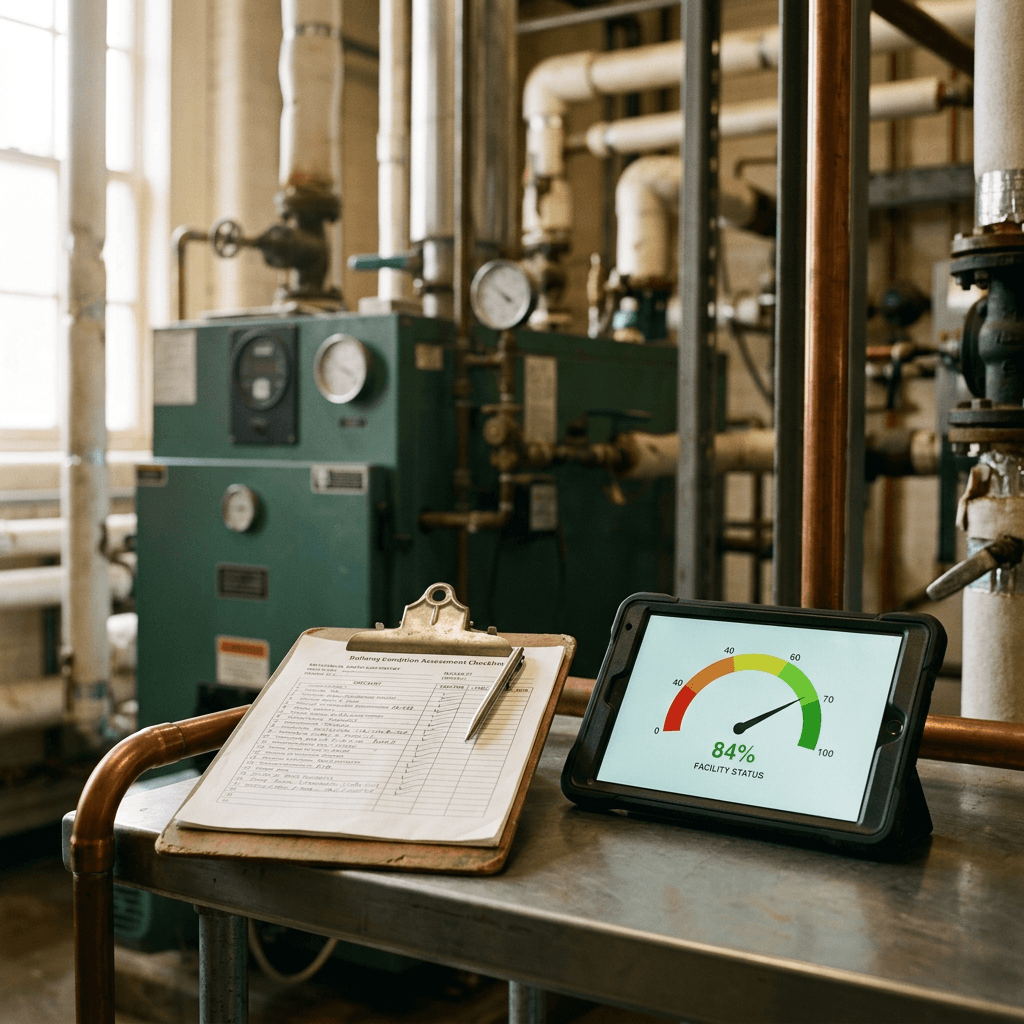
The facility condition index is a ratio of what a building needs spent on it to what it would cost to replace. Deferred maintenance and capital renewal need goes on top, current replacement value goes underneath, and the result is read as a decimal or a percentage, where lower is better. It exists to make the condition of hundreds of buildings comparable on one scale.
It does that job well for portfolios of owned buildings, which is what it was designed for. It does something misleading on a portfolio of leased stores, and the reason is in the arithmetic rather than in the practice.
The formula, and what belongs in each term
FCI = ********
The numerator is the estimated cost of correcting condition and code deficiencies. In practice it is the output of a facility condition assessment, the survey that walks a building, inventories systems and prices the work. APPA frames the measure at portfolio level as "deferred and current capital renewal needs divided by the total current replacement value of the managed assets and systems within the portfolio" (APPA).
The denominator is current replacement value, meaning what it would cost to build the facility again today at equivalent capacity, not book value and not market value. That distinction matters more than it sounds. A fully depreciated building has a book value near zero and a replacement value in the millions, and using the wrong one produces a score off by an order of magnitude.
Two decisions drive most of the variation between organizations. What counts as a deficiency, since an assessor with a ten year horizon prices more work than one with a five year horizon. And what sits in the replacement value, since including or excluding site work, equipment and soft costs moves the denominator substantially. Neither is standardized enough to compare scores across organizations without asking how each was built.
What the score means, and the funding benchmark behind it
The conventional bands are under 0.05 for good condition, 0.05 to 0.10 for fair, and above 0.10 for poor. They are widely used, they are useful, and they are conventions rather than physics. A 0.11 is not a different category of building from a 0.09.
More useful than the band is the funding level the index is supposed to inform. APPA cites the Building Research Board recommendation of 2 to 4 percent of aggregate current replacement value annually to keep a portfolio from degrading, structured as roughly 0.5 to 1.5 percent for operations and maintenance and 1.5 to 2.5 percent for life cycle renewal, and explicitly excluding any one-time funding aimed at reducing an existing backlog (APPA).
That last exclusion is the part people skip. The 2 to 4 percent keeps the score where it is. Improving a score means spending that, plus the backlog, which is why portfolios that fund at the benchmark and expect the index to fall are disappointed a year later.
Where the index assumes you own the building
Every part of the construction above assumes one organization owns the asset, carries the deficiencies, funds the renewal and captures the benefit. On a leased site none of those four is reliably true.
Start with the denominator. Current replacement value asks what it would cost to rebuild the facility. For a leased store, the occupier will never rebuild it, is not permitted to, and would not own it if they did. The landlord holds the shell and structure. Putting the building's replacement value underneath an occupier's maintenance backlog measures that backlog against an asset belonging to someone else, which produces a flattering score for exactly the wrong reason: the denominator is large because the building is valuable, not because the occupier's position is sound.
Then the numerator. A condition assessment walks the site and prices every deficiency it finds, including the roof, the structure, the parking lot and the common area systems. On a leased site a significant share of that work is the landlord's obligation. Some of it will reach the occupier anyway, through CAM, and some will not reach them at all. The assessment is describing the building. The lease decides whose problem each line is.
Splitting the numerator by lease clause
This is the work that has to happen before a condition assessment means anything on a leased portfolio. The allocations below are the common pattern, not a rule. What governs is your lease.
| Building element | Who typically carries it | How the cost usually reaches the occupier | What in the lease decides |
|---|---|---|---|
| Roof and structure | Landlord | Often not at all, though some net leases push roof repair to the tenant | The repair and maintenance clause and any structural carve-out |
| HVAC serving the premises | Tenant, under most net leases | Direct cost | Whether equipment exclusively serving the premises is assigned to the tenant, and any repair versus replacement threshold |
| Parking, sidewalks, exterior lighting | Landlord performs the work | CAM pass-through, subject to exclusions, caps and amortization terms | The CAM definition and how capital expenditure is treated, which is the subject of CAM exclusions to negotiate |
| Systems serving multiple tenants | Landlord performs the work | CAM pass-through | The same CAM language, plus any proportionate share definition |
| Tenant fit-out, finishes and fixtures | Tenant | Direct cost during the term, and a restoration cost at the end of it | The alterations clause and the surrender clause |
| Code compliance triggered by the tenant's use | Tenant, usually | Direct cost | The compliance clause and which party's activity triggered the requirement |
| Life safety and accessibility in common areas | Landlord performs the work | CAM, where the lease permits it | Whether the lease excludes compliance-driven capital from recoverable costs |
Two consequences follow. First, a portfolio-wide deficiency total taken straight from an assessment overstates the occupier's exposure, sometimes substantially, because it includes work the landlord owes. Second, and less obvious, it also understates a different exposure, because the CAM column is real money the occupier funds without controlling the scope, the timing or the procurement. That is a cost line, and it is auditable, which is the discipline in auditing pass-through charges.
None of this split is possible without the repair, CAM and surrender clauses being captured accurately for every site, which is upstream lease work rather than facilities work. See lease abstraction.
Remaining term changes the answer
An owned building has an indefinite horizon, so a deficiency is a question of when rather than whether. A leased site has an expiry date, and that changes what a deficiency even is.
A chiller with eight years of life left at a site with three years remaining on the lease is not a capital renewal item. It is either the landlord's problem after you leave, or it is a negotiating position at renewal, depending on the lease. Ranking it alongside a genuine deficiency at a site you will hold for fifteen more years produces a capital plan that spends money in the wrong places.
The expiry also converts deferred maintenance into a different kind of liability. Where the lease requires the premises returned in a specified condition, the maintenance you deferred during the term resurfaces at the end as a surrender or restoration obligation, with a date and a counterparty. That is an occupancy cost event, and it typically lands on a different budget and a different team than the one that deferred the work. A condition backlog on a leased site is not open-ended. It has a deadline written into the lease.
A version that works on a leased portfolio
The index is worth keeping. It needs three adjustments before it says anything true about leased sites.
- 01Filter the numerator to what the lease makes yours. Run every assessed deficiency against the repair and maintenance clause for that site before it enters the total. Keep the landlord-obligation items in a separate register, because they are a different conversation, one you have with the landlord rather than with your capital committee.
- 02Track CAM-recoverable deficiencies as a third category. Not yours to fix, not free either. This is the line that gets missed, and it is the one where an occupier can influence cost through the lease's exclusions, caps and amortization terms rather than through a work order.
- 03Change the denominator to what you actually own. For a leased site that is the depreciated replacement cost of the fit-out and the equipment you hold, not the building. It produces a higher and less comfortable ratio, which is the point, because it measures your position rather than the landlord's asset.
- 04Weight by remaining term. Score deficiencies against the time you will hold the site. A separate flag for anything that becomes a surrender obligation at expiry is worth more than another decimal place.
- 05Re-run it more often than the assessment cycle. A point-in-time assessment ages, which is the argument the facility condition assessment piece makes in detail, and the lease-driven allocation ages too, because amendments change who owes what.
Done this way the number stops being a building metric and becomes a portfolio one, which is what a multi-site occupier needed in the first place. It also joins up with the capital plan rather than sitting beside it: see capital planning with asset lifecycles and the broader picture in facility management for multi-site occupiers. The day to day work of keeping the underlying asset data current sits in preventive maintenance.
FAQ
How is the facility condition index calculated?
- Divide the cost of correcting deferred maintenance and capital renewal deficiencies by the current replacement value of the facility, then express the result as a decimal or percentage. APPA states the portfolio-level version as deferred and current capital renewal needs over the total current replacement value of the managed assets and systems. Current replacement value means the cost to rebuild at equivalent capacity today, not book value and not market value.
What is a good facility condition index score?
- The conventional bands are under 0.05 for good, 0.05 to 0.10 for fair, and above 0.10 for poor. Treat them as conventions rather than thresholds with anything physical behind them, and be careful comparing scores between organizations, because what counts as a deficiency and what sits inside replacement value both vary enough to move a score materially.
What is the difference between a facility condition index and a facility condition assessment?
- The assessment is the survey. It walks the building, inventories systems, and prices the deficiencies it finds. The index is the single number produced from that survey by dividing the deficiency cost by replacement value. One is the fieldwork, the other is the metric, and an index is only as good as the assessment behind it and as current as the date it was done.
Does the facility condition index work for leased buildings?
- Not without adjustment. Both terms assume ownership: the denominator is the replacement value of a building the occupier does not own, and the numerator includes deficiencies that are the landlord's obligation under the lease. A usable version filters the deficiencies to those the lease assigns to the tenant, tracks CAM-recoverable items separately, uses the value of the tenant's own fit-out and equipment as the denominator, and weights everything by remaining lease term.
How much should we budget to keep the score from getting worse?
- APPA cites a Building Research Board recommendation of 2 to 4 percent of aggregate current replacement value per year, roughly 0.5 to 1.5 percent for operations and maintenance and 1.5 to 2.5 percent for life cycle renewal. That level maintains the current position. Reducing an existing backlog requires funding on top of it, which the recommendation explicitly excludes.
More From Our Blog
More
Predictive maintenance for multi-site portfolios: what it actually saves
Predictive maintenance is a budgeting advantage before it is a technology one. Here is what it saves across a leased, multi-site portfolio.
Preventive vs predictive maintenance: which lowers cost across a portfolio?
Preventive bills on a calendar; predictive bills on condition. Here is which lowers cost across a multi-site portfolio, and where each one wins.

The 8 best enterprise asset management software options for multi-site occupiers in 2026
Enterprise asset management software was built for the factory floor. Here are the 8 best options for multi-site occupiers in 2026, ranked.

Initial agents live in two weeks.
Start with one or two high-value workflows, connect the required data and documents, measure the result, then expand across domains.
- A tailored onboarding for every enterprise.
- Fitted to how you actually work.
- Continuous support as your portfolio evolves.