Published:
Last updated:
Predictive maintenance for multi-site portfolios: what it actually saves
Predictive maintenance is a budgeting advantage before it is a technology one. Here is what it saves across a leased, multi-site portfolio.
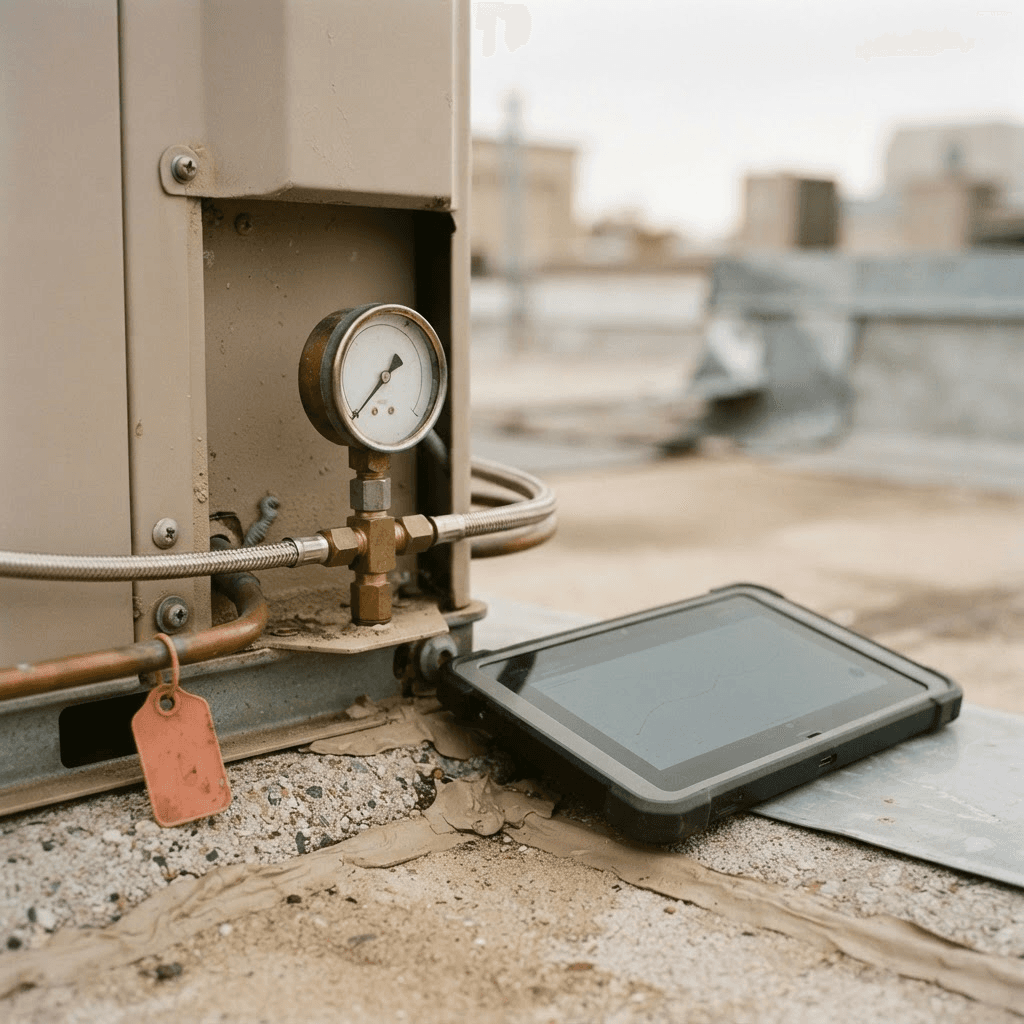
Predictive maintenance is a way of timing repairs around the measured condition of an asset rather than a fixed schedule or a breakdown. Sensors and building system data flag the early signs of wear, and the work gets done before the asset fails but no sooner than it needs to. For a company running a hundred or more leased locations, the point is not the sensor. The point is that you stop paying the premium that unplanned failures add to an already large operating budget.
That premium is the part of the budget nobody plans for. A rooftop HVAC unit that fails in July is not a line item, it is a same-day emergency: a contractor at after-hours rates, a part shipped overnight, a location that trades hot or closes, and customers who notice. In a single building that is a bad week. Across a portfolio it is a structural cost that hides inside facilities and CAM, and it is almost always larger than the planned maintenance it replaced.
What is predictive maintenance, and how is it different from preventive?
Predictive maintenance triggers work when condition data says an asset is heading toward failure. Preventive maintenance triggers work on a calendar, every quarter or every so many run-hours, whether the asset needs it or not. Reactive maintenance does nothing until something stops working. All three do the same physical tasks, replace a part, service a unit, fix a fault. The difference is the timing, and the timing is where the money is.
Calendar-based preventive maintenance has two failure modes that both cost money. It over-services healthy equipment, so you pay for parts and labor you did not need. And it still misses failures that develop between scheduled visits, because a fixed schedule cannot see a bearing starting to go in week six. Predictive maintenance closes both gaps: it leaves a healthy asset alone and it catches the developing fault early, when the fix is small and can be scheduled into a planned window instead of an emergency one.
Why reactive maintenance is the most expensive way to run a portfolio
Reactive maintenance looks cheap because you only pay when something breaks. The bill arrives later, and it is bigger than it looks. According to the US Department of Energy’s Operations and Maintenance Best Practices Guide, a working predictive program runs about 8 to 12 percent below a preventive one, and a portfolio leaning on predictive and condition-based methods can spend up to roughly 40 percent less than one that stays reactive. Catching a fault early is the same discipline as sequencing capital around asset lifecycles.
The reason is in the cost lines a reactive failure touches. Emergency labor is billed at a premium and often after hours. Parts ship expedited rather than ground. A failure that was never caught early tends to take other components with it, so you replace an assembly instead of a part. And the asset itself wears out faster under run-to-failure, which pulls forward the capital cost of replacing it. For a leased site, there is a further line most maintenance comparisons miss: a meaningful share of these costs are recoverable or passed through, so a reactive culture quietly inflates occupancy cost and CAM across the whole portfolio.
Reactive, preventive, and predictive, on cost
| Reactive | Preventive | Predictive | |
|---|---|---|---|
| When work happens | After failure | On a fixed schedule | When condition data warrants |
| Labor | Emergency, often after-hours, premium rate | Planned, standard rate | Planned, fewer visits |
| Parts | Expedited, full-assembly replacement | Routine, sometimes replaced early | Ordered ahead, replaced when needed |
| Business impact | Closed or degraded location, lost trade, complaints | Minimal, planned windows | Minimal, planned windows |
| Asset life | Shortened by run-to-failure | Extended, but over-servicing wastes spend | Extended, serviced only when needed |
| Budget behavior | Unpredictable spikes | Predictable but often over-spent | Predictable and targeted |
| Relative cost (US DOE) | Highest | Lower | About 8 to 12% below preventive; up to about 40% below reactive |
What predictive maintenance changes for a leased portfolio
Most published guidance on predictive maintenance is written for factories: production lines, rotating machinery, output per hour. The economics read differently when the assets are spread across leased retail, office, and service locations. Your critical equipment is HVAC and rooftop units, refrigeration, elevators, and electrical and lighting infrastructure. A failure does not stop a production line, it closes a store, spoils inventory, or generates a tenant complaint and a landlord dispute over who pays.
Two things follow from that. First, condition-based timing matters more when the portfolio is large and dispersed, because you cannot send a technician to look at every unit at every site, so you let the data tell you which of the thousands of units actually needs attention this month. Second, the maintenance decision is also a real estate decision. There is little sense spending capital to extend the life of a chiller in a location you plan to exit at the next break option, and every sense in front-loading attention on the sites you are renewing or expanding. That only works when maintenance condition data sits next to lease term, critical dates, and capital plans rather than in a separate system.
This is where REAL’s facilities work fits. REAL runs facilities alongside lease administration, property tax recovery, and construction on one platform, so a maintenance signal is read in the context of the lease and the location, not in isolation. The framing REAL uses for the whole platform applies cleanly here: recover cost across every location you run.
How to start without sensors on everything
The fastest way to waste money on predictive maintenance is to instrument the whole estate at once. The return concentrates on a few asset classes, so start there and expand on evidence.
- 01Pick the assets where a failure is expensive. For most occupiers that is HVAC and rooftop units, refrigeration, and elevators, plus electrical infrastructure at larger sites.
- 02Set a baseline for what healthy looks like on those assets, so a deviation is meaningful rather than noise.
- 03Monitor condition on that short list first. Resist adding low-cost, low-impact assets until the critical ones are proven.
- 04Route what the data finds into the work order process you already run, so an early warning becomes a scheduled job, not another dashboard.
- 05Tie the spend to lease term and capital plans, so you invest in the locations you are keeping and stop over-maintaining the ones you are leaving.
- 06Measure against your reactive baseline, then expand to the next tier of assets and sites.
The takeaway is plain. Predictive maintenance is worth doing where failure is costly and the portfolio is too large to watch by hand, which describes most enterprise occupiers. Treated as a budgeting tool rather than a technology project, it lowers the part of facilities spend you cannot currently see, and feeds the same occupancy-cost decisions that decide which locations to keep.
Frequently asked questions
Is predictive maintenance worth it for a smaller portfolio?
- It depends on asset criticality more than site count. If a single failure closes a location or spoils stock, condition monitoring on that asset can pay for itself quickly, even at ten sites. If your assets are low-cost and easy to replace, a good preventive schedule is often enough.
Which assets are the best candidates in retail and office sites?
- The high-cost, high-impact ones: HVAC and rooftop units, refrigeration, elevators, and electrical infrastructure. These are where an unplanned failure carries emergency labor, expedited parts, and lost trading or tenant disruption, so catching the fault early returns the most.
Does predictive maintenance replace preventive maintenance?
- No. Most portfolios run a hybrid: predictive on the high-criticality assets where it pays, preventive on moderate-risk systems, and reactive only on low-cost assets where running to failure is genuinely cheaper. The goal is matching the method to the asset, not picking one for everything.
How does predictive maintenance affect CAM and pass-through costs?
- Reactive failures carry premium emergency costs, and a share of those costs flow through CAM and occupancy cost. Reducing unplanned failures lowers the recoverable maintenance spend in the first place, which is why facilities timing and lease accounting belong in the same view.
See REAL run end to end.
Watch a demoRelated posts
Preventive vs predictive maintenance: which lowers cost across a portfolio?
Preventive bills on a calendar; predictive bills on condition. Here is which lowers cost across a multi-site portfolio, and where each one wins.

The 8 best enterprise asset management software options for multi-site occupiers in 2026
Enterprise asset management software was built for the factory floor. Here are the 8 best options for multi-site occupiers in 2026, ranked.

Capital planning that respects asset lifecycles
Sequencing replacements across locations so capital lands where it returns the most.