Build vs buy lease accounting software: what ASC 842 asks you to maintain
Last updated:
8 min read

Should you build or buy lease accounting software? For most multi-site occupiers, buy the foundation and put your own effort into the close controls that are specific to you. Any capable finance team can model a right-of-use asset and a lease liability. What costs real money is keeping each schedule tied to the current lease, through every amendment, option reassessment and index reset, with evidence an auditor will accept at quarter close. Your close calendar, thresholds and approval chain are where your team adds value.
That distinction matters more now than it did at adoption. ASC 842 took effect for public business entities in fiscal years beginning after December 15, 2018, and for all other entities in fiscal years beginning after December 15, 2021, according to the FASB's ASU 2016-02 summary_(Rev_6-3-20).pdf). IFRS 16 applied to annual periods starting on or after January 1, 2019, per the IFRS Foundation. Most companies built something under deadline pressure. The question today is whether that something holds up year after year.
This piece is part of our series on build vs buy AI agents for corporate real estate.
What does "build" mean for lease accounting?
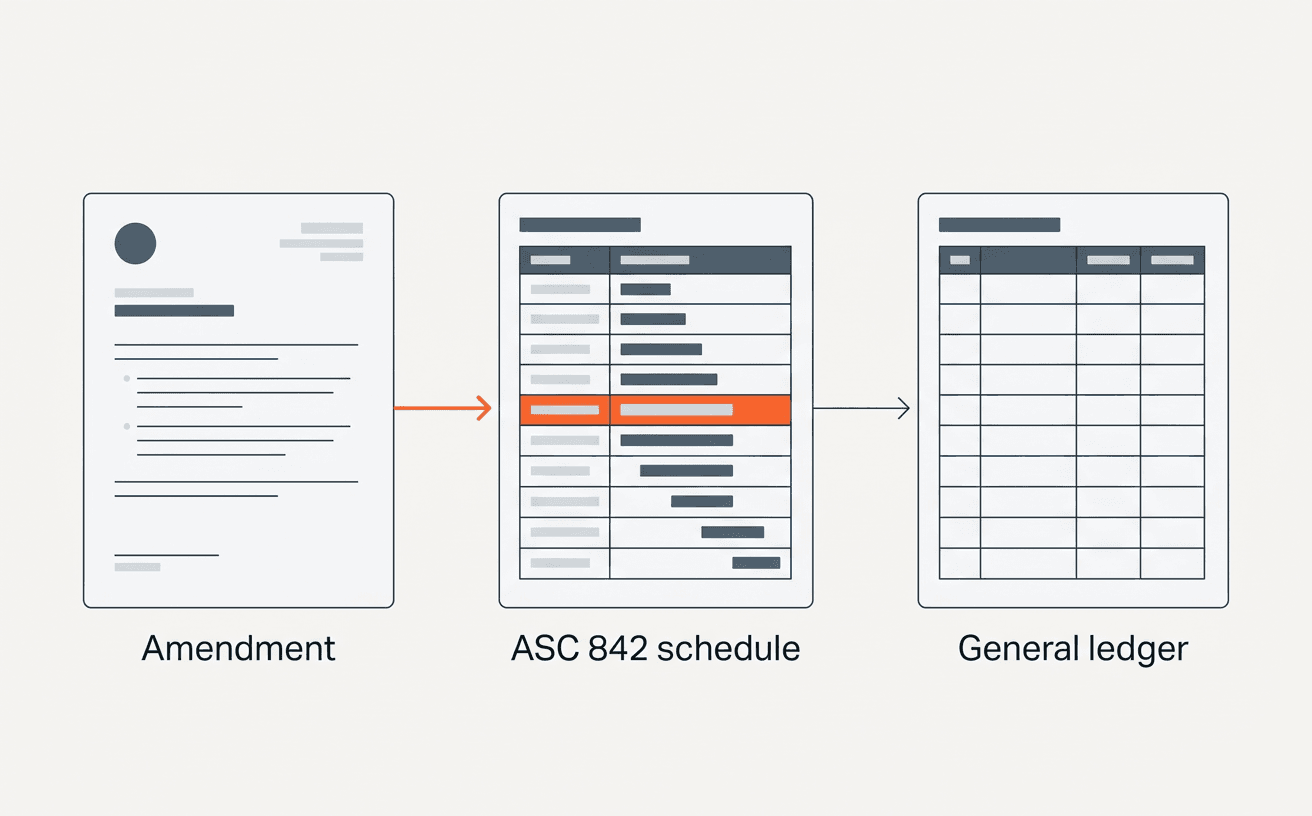
Building lease accounting usually takes one of three forms. The first is a spreadsheet model per lease or per portfolio, maintained by the accounting team. The second is a lease module inside the ERP, configured and fed by internal staff. The third is a custom tool, sometimes scripts in a data warehouse, sometimes a newer setup where a language model reads leases and pushes terms into a calculation engine. All three can produce correct journal entries on day one. The difference shows up in the components you have to keep running after go-live.
| Component | What it involves | Who owns it after go-live |
|---|---|---|
| Lease population | Finding every lease, including embedded leases in service contracts | Accounting plus lease administration |
| Abstraction | Commencement, term, payments, options, reasonably certain renewals, pulled from the document | Whoever reads the lease |
| Classification and measurement | Finance vs operating, incremental borrowing rate, ROU asset and liability | Technical accounting |
| Remeasurement triggers | Amendments, term changes, option reassessments, index-linked payment changes | Someone has to notice them first |
| Journal entries and disclosures | Monthly postings, maturity analysis, quarterly and annual disclosures | Close team |
| Audit evidence | Tying each input back to a clause and a signed document | Close team, every quarter |
| Connections | Lease administration system to calculation to ERP and general ledger | IT or finance systems |
| Controls and change management | Access, reviews, staff turnover, model or formula changes | Controller |
Where do spreadsheets and ERP lease modules break?
Spreadsheets and ERP lease modules break at the inputs, not the math. A typical failure looks like this: an amendment extending a store's term is signed in the field in March. The lease administration system is updated in May. The accounting team learns about it at quarter close, or at the next audit, and books a catch-up. The calculation was correct. It was calculating the wrong lease.
The EY and LeaseAccelerator 2022 Global Lease Accounting Survey, as reported by Compliance Week, captures the pattern. 38% of respondents still relied on spreadsheets. The top audit challenges were completeness of the lease population (32%), out-of-period adjustments (30%) and timely lease capture (28%). 48% said lease accounting was not fully integrated with the close. Every one of those is a data problem upstream of the calculation.
Index-linked rent adds a quieter version of the same problem. Under IFRS 16, a change in payments driven by an index generally triggers remeasurement when the cash flows change. Under ASC 842, an index reset alone generally does not remeasure the liability, but the new payment still has to flow through as variable lease cost, and the updated index is used whenever the lease is remeasured for another reason. A homegrown model has to encode both behaviors and know which entity follows which standard. See how REAL handles CPI rent escalations.
When does building lease accounting make sense?
Building is a sound choice in a few specific situations, and it is worth saying so plainly:
- The portfolio is small and stable. A few dozen leases with rare amendments can live in a well-controlled spreadsheet with a documented review.
- You already own the ERP module and the lease data is clean. If lease administration is disciplined and amendments reach finance within days, configuring the module you have may be enough.
- The structures are unusual. Some sale-leasebacks, build-to-suit arrangements or heavily customized equipment leases need logic a packaged tool handles awkwardly.
- A finance systems team already runs a lease data pipeline. In that case you are extending a system, not starting one.
Outside those cases, the build tends to look cheap in the first budget and expensive by the third year, once remeasurements, audit tie-outs and staff turnover arrive. We work through the full cost in what it costs to build and run your own AI for real estate operations.
The third path: buy the lease record, run your own close workflows
The third path is to buy the lease record and the accounting core, then run the workflows that are specific to your company on top. Your close calendar, your materiality thresholds, your approval chain and your exception reports are yours. Lease abstraction and remeasurement logic are the same work for every occupier, and they are the part worth buying.
Ask every vendor who builds those workflows. Some expect your finance systems team to build them on their platform, which brings part of the run cost back. With REAL, you define the rules and REAL's engineers build and maintain each workflow on the shared record, through custom workflows. One example is a payment exception review that checks every rent and CAM charge against lease terms and escalation math before it is paid, routed to the approvers you name. The calculation layer is bought. The control design is yours.
What REAL does here
REAL's lease accounting agent maintains ASC 842 and IFRS 16 accounting from the governing lease, including classification, ROU asset and liability, payment and maturity schedules, remeasurements on amendments, journal entries and disclosures. It feeds your ERP and general ledger rather than replacing them. Judged on the standard that matters:
- Action: a new amendment flags the remeasurement and produces the updated schedule and journal entries for approval in the right period.
- Evidence: every figure links to the clause and signed document it came from, so the quarterly tie-out starts from the source.
- Outcome: because the same portfolio record drives CAM review and payment checks, accounting hears about a change when the document arrives. Existing REAL clients see a 10.3% average CAM savings.
For a category view of tools on the market, see ASC 842 software.
Build vs buy scorecard for lease accounting software
| Criterion | Build (spreadsheet, ERP module, scripts) | Buy | Buy + run your workflows on top |
|---|---|---|---|
| Time to first compliant close | Fast if data is clean, slow if not | Weeks, depends on data | Weeks, plus your workflows |
| Amendments reach accounting | Depends on manual handoffs | Flagged when the document arrives | Flagged, routed your way |
| Audit evidence per input | Manual tie-out each quarter | Clause-level links | Clause-level links |
| Index-linked rent under both standards | You encode and maintain it | Vendor maintains it | Vendor maintains it |
| Fit to your close and controls | Full | Partial | Full |
| Ongoing ownership | Your team, indefinitely | Vendor plus your reviewers | Vendor core, your rules |
| Best for | Small, stable portfolios | Large, active portfolios | Large portfolios with specific controls |
Questions to ask before you decide
- How many amendments, renewals and terminations did we process last year, and how many reached accounting in the same period?
- How many out-of-period lease adjustments did we book in the last eight quarters?
- Can we show an auditor the clause behind every commencement date, payment and option assumption?
- Who maintains the model when its author leaves?
- Which entities report under IFRS 16 and which under ASC 842, and does our model treat index changes correctly for each?
- Which close workflows would we define first if the calculation layer were already handled, and who would build them?
Lease accounting is only as current as the lease data behind it. When amendments reach finance in the period they affect, the close holds. Related reading: lease remeasurement checklist and, upstream, build vs buy for AI lease abstraction.
FAQ
Can an ERP handle ASC 842 on its own?
- Many ERPs include a lease accounting module that can calculate liabilities, ROU assets and journal entries. The module depends on someone entering correct lease terms and updating them when leases change. The gap is usually abstraction and change capture rather than calculation, so an ERP module works best when lease administration feeds it promptly and with source evidence.
Is Excel acceptable for ASC 842 compliance?
- No standard prohibits spreadsheets, and many companies still use them. The EY and LeaseAccelerator 2022 survey found 38% of respondents relied on spreadsheets. The risk grows with portfolio size: manual handoffs, version control and tie-outs to source documents become harder to evidence each quarter.
Do CPI increases trigger remeasurement under ASC 842?
- Generally not on their own. Under ASC 842, a change in an index-linked payment is recognized as variable lease cost, and the updated index is used when the lease liability is remeasured for another reason. Under IFRS 16, a change in index-linked payments generally triggers remeasurement when cash flows change. Confirm treatment with your auditors.
How long does it take to switch lease accounting software?
- It depends mostly on the state of your lease data. Collecting a complete lease population with current amendments is usually the longest step. REAL's onboarding plan puts initial agents live in two weeks, running in parallel with the existing process before the team takes control.
Who builds the close and review workflows if we buy?
- It depends on the vendor, so ask before you sign. Some expect your finance systems team to build on their platform. With REAL, you define the rules, such as a payment exception review or your materiality thresholds, and REAL's engineers build and maintain the workflow on the shared record.
More From Our Blog
More
Closing under ASC 842 without quarter-end surprises
Where lease accounting breaks down at scale, and how to keep every figure traceable to the clause behind it.

A remeasurement checklist for changing leases
The events that trigger a remeasurement, and how to post each one without breaking the audit trail.

What IFRS 16 software needs to do, and why a spreadsheet stops being enough
IFRS 16 puts nearly every lease on the balance sheet under one model. The software that handles it well earns trust on remeasurement, not day one.

Initial agents live in two weeks.
Start with one or two high-value workflows, connect the required data and documents, measure the result, then expand across domains.
- A tailored onboarding for every enterprise.
- Fitted to how you actually work.
- Continuous support as your portfolio evolves.