What is AI lease abstraction?
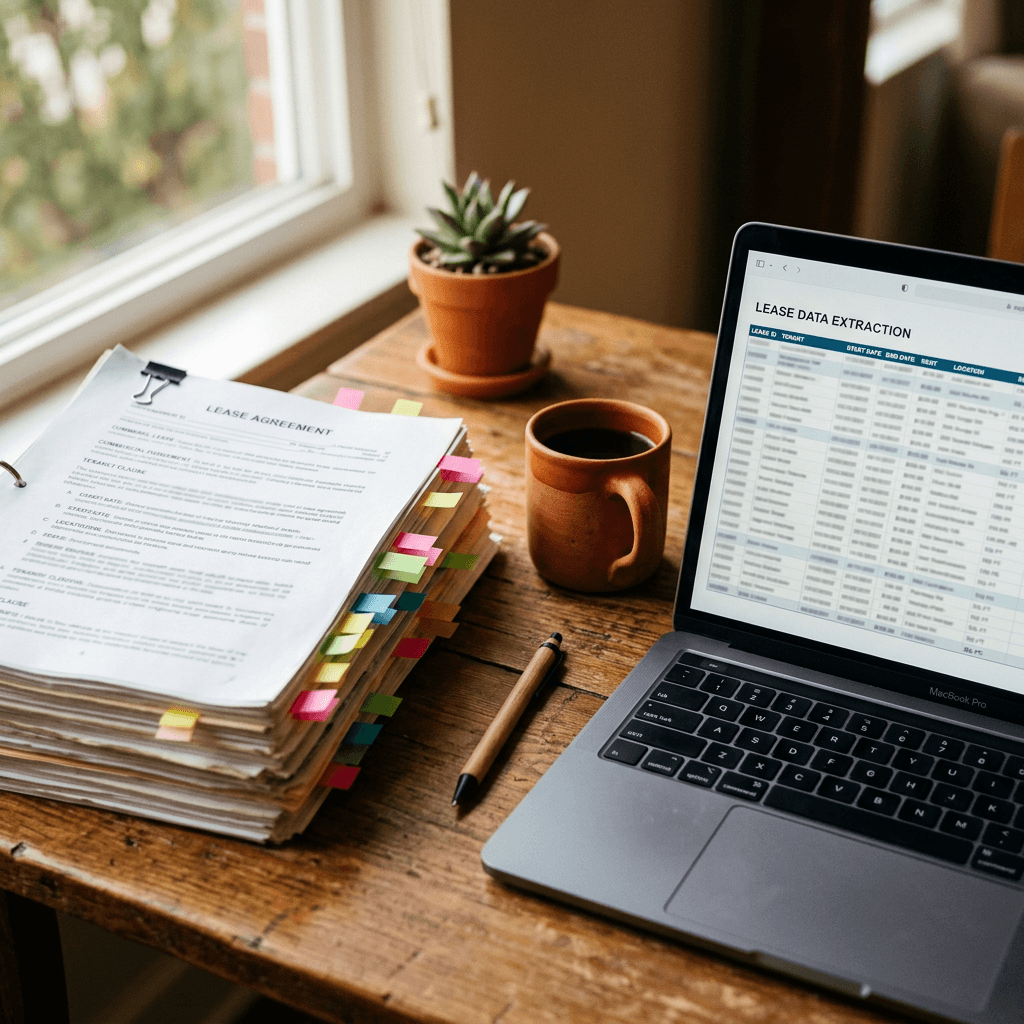
AI lease abstraction is the use of software to read a commercial lease and its amendments and extract the terms that drive decisions into structured fields: commencement and expiration dates, base rent and escalations, CAM and other pass-throughs, caps and exclusions, renewal and termination options, notice periods, holdover, co-tenancy and tenant improvement allowances. A good abstract links every field to the page and section it came from, so a lease administrator or auditor can check it. A commercial lease typically runs 30 to 120 pages before amendments, and REAL's published market ranges put manual abstraction at 2 to 6 hours of analyst time per lease, with outsourced services typically taking 3 to 10 business days and $75 to $400 per lease, based on commonly published market figures (real.dev/lease-abstraction). Software changes the economics. It does not remove the need to verify.
What does the DIY approach look like?
The DIY approach usually starts with a general chatbot. Someone uploads a lease, writes a careful prompt listing the fields they want, and gets a clean summary back. For a single lease, the result is often good. Teams then scale it up with a prompt library, a spreadsheet to collect outputs and, sometimes, a script that calls a model through an API. This is a fair way to start. It teaches the team what the software is good at, it is cheap, and it shows quickly whether abstraction is the real bottleneck. The problems appear later and are predictable: amendments that change earlier terms, scanned exhibits, side letters, inconsistent outputs from one run to the next, and no record of where a value came from. Research on long documents shows why. Stanford researchers found that model performance degrades when the relevant information sits in the middle of a long input (Liu et al., TACL 2024), which is where a renewal option on page 47 tends to live.
What would you have to build to run abstraction in production?
| Component | Why it matters for leases |
|---|---|
| Intake for PDFs, Word files and scans with OCR | Older leases and exhibits are often scanned |
| Field schema for your portfolio | Retail, office and industrial leases carry different terms |
| Clause-level source links | Auditors and lease admins need to verify each value |
| Amendment and side-letter handling | A 2022 amendment overrides a 2015 rent table |
| Confidence scoring and review queue | Uncertain fields go to a person, not straight to the ledger |
| Consistency controls | The same lease should return the same answer every run |
| Change log and versioning | You need to see what changed and when |
| Export and connections | Abstracts feed lease accounting, CAM review and critical dates |
| Model monitoring and updates | Models change; accuracy needs to be re-checked |
Why does accuracy matter more than speed?
Accuracy matters more than speed because an abstract is only useful if someone can act on it without re-reading the lease. A missed renewal window or a wrong escalation rate costs far more than the hours saved. Stanford RegLab and HAI found that even purpose-built AI legal research tools produced hallucinations on 1 in 6 or more benchmark queries (Stanford HAI, May 2024). Lease abstraction is a narrower task than legal research, but the lesson holds: a fluent answer is not the same as a correct one. That is why the source link on each field, and a review queue for low-confidence fields, matter more than any speed claim. If the abstract cannot show its work, someone will end up re-reading the lease anyway, and the saving disappears.
Abstract to action
A good abstract of one lease is easy. Keeping a portfolio current is the work.
- 1
Extract the fieldsWhere most tools stop
Dates, rent, escalations, pass-throughs and options.
- 2
Cite the clauseWhere the value is
Link each field to the page and section it came from.
- 3
Apply amendments
Supersede earlier terms and keep the history.
- 4
Review the exceptions
Route low-confidence fields to lease administration.
- 5
Feed downstream work
Send terms to lease accounting, CAM review and critical dates.
When does building your own abstraction make sense?
Building your own makes sense when the volume is low or the job is temporary. Specifically:
- One-time diligence. Reviewing 60 leases for an acquisition or disposition, with a lawyer checking the output, is a good DIY job.
- A small portfolio. A few dozen leases with an experienced lease administrator may not justify software.
- A single narrow field. Pulling one clause type, such as a radius restriction, across a set of leases.
- A standing data team. If you already maintain a lease data warehouse with engineers who know real estate, an internal build is credible.
If the abstracts will feed ASC 842 schedules, CAM checks or critical date tracking across hundreds of locations, the maintenance burden usually outweighs the savings.
What is the third path?
The third path is to buy abstraction and a shared portfolio record, then build the reviews that are specific to you. The vendor handles intake, extraction, source links, amendments and model updates. Your team designs the checks you care about: every lease with a co-tenancy clause tied to a specific anchor, every escalation that differs from what AP is paying, every location where the lease area differs from the as-built. REAL supports this through custom workflows on your own lease data. You keep control of the logic without owning the plumbing.
Ownership map
What your organization owns under each approach
| Layer | Build | Buy | Foundation + extend |
|---|---|---|---|
| AI models and infrastructure | Internal team | Platform provider | Platform provider |
| Document processing and evaluation | Internal team | Platform provider | Platform provider |
| Real estate domain logic | Internal team | Platform provider | Platform provider |
| Integrations with your systems | Internal team | Shared responsibility | Shared responsibility |
| Workflows, rules and approvals | Internal team | Shared responsibility | Shared responsibility |
| Business decisions | Customer-controlled | Customer-controlled | Customer-controlled |
Cost timeline
Most of the cost arrives after the system goes live
- Initial developmentIncurred before production
- Data preparation and validationIncurred before production
- Production deploymentIncurred before production
- Ongoing engineeringRecurring after production
- Model and infrastructure costsRecurring after production
- Testing and exception handlingRecurring after production
- Potential cost of delayIncurred before production
Decision scorecard
| Criterion | Build (chatbot + prompts or in-house) | Buy | Buy + build on top |
|---|---|---|---|
| Cost to start | Very low | Subscription | Subscription |
| Single-lease quality | Often good | Good | Good |
| Amendment handling | Manual | Built in | Built in |
| Source link on each field | Rarely | Check before buying | Inherited |
| Repeatable results | Inconsistent | Consistent | Consistent |
| Feeds accounting and CAM | Manual re-key | Connected | Connected, plus your checks |
| Run cost at 1,000+ leases | High | Vendor carries it | Vendor carries it |
Questions to ask before you decide
- How many leases, amendments and side letters are in scope, and how many change each year?
- Who checks the abstract, and how long does a check take?
- Can every field be traced to a page and section?
- What happens to last year's abstract when an amendment arrives?
- Where do the abstracts go next: lease accounting, CAM review, critical dates?
What REAL does here
REAL's lease abstraction agent reads leases, amendments, exhibits and side letters in any format, links every field to its clause, re-abstracts when an amendment arrives and flags low-confidence fields for review. To test the output yourself, the free lease abstraction tool returns a first-pass abstract of a single lease in under 3 minutes with 150+ structured data points, each linked to its clause. For the wider picture, see how AI lease abstraction works in CRE, the build vs buy AI agents framework for corporate real estate, and the companion piece on build vs buy critical date tracking. Or book a walkthrough.
FAQ
Can ChatGPT or Claude abstract a lease?
- Yes, a general chatbot can produce a useful summary of a single lease, and it is a fair way to test the idea. The limits show up at portfolio scale: amendments, scanned exhibits, inconsistent outputs between runs, and no built-in link from each value to its clause. Treat chatbot abstracts as drafts that need checking.
How long does lease abstraction take?
- Manual abstraction typically takes 2 to 6 hours per lease, and outsourced services typically return abstracts in 3 to 10 business days, according to market ranges published by REAL. Software can produce a first-pass abstract in minutes. Review time depends on lease complexity and how well the software flags uncertain fields.
Is lease abstraction software better than a lease abstraction service?
- It depends on volume and frequency. A service suits a one-time backlog with human review included. Software suits ongoing work, because new leases and amendments keep arriving and the abstract has to stay current.
What fields should a lease abstract include?
- At minimum: parties, premises, commencement and expiration dates, base rent and escalations, pass-throughs and caps, renewal and termination options with notice periods, holdover, assignment and subletting, co-tenancy, and tenant improvement allowance terms. Each should carry a reference to its clause.
More From Our Blog
More
Best lease management software for enterprise tenants
Six platforms compared on the criteria a large occupier actually weighs: abstraction at scale, critical dates, CAM recovery, ASC 842, ERP fit, and deployment.

Reading every lease before the renewal clock runs out
A practical approach to tracking critical dates and obligations across hundreds of leases without a bigger team.

Recovering tenant improvement allowances you already earned
TIA dollars expire quietly. Here is how to find and collect them before the window closes.

Initial agents live in two weeks.
Start with one or two high-value workflows, connect the required data and documents, measure the result, then expand across domains.
- A tailored onboarding for every enterprise.
- Fitted to how you actually work.
- Continuous support as your portfolio evolves.