Build vs buy lease administration software for critical dates and notices
Last updated:
8 min read

Should you build your own critical date tracking or buy lease administration software? If you hold more than a handful of leases with options, buy the date engine and put your own effort into how your company decides: which deadlines go to the real estate committee, who reviews first, when the site review starts. A date in a spreadsheet costs nothing. The expensive part is turning clause language into the correct notice window, keeping it correct after every amendment, and making sure the right person sends the right notice the right way.
Critical lease dates are the deadlines a lease creates: rent commencement, expiration, renewal and termination option windows, co-tenancy cure periods, kick-out rights, and notice deadlines tied to each. Exercise a renewal option on time and you keep its protected terms; let it lapse and you negotiate from weakness or sit in holdover. Catch a termination window and you can exit a site you meant to leave, instead of carrying it for another term.
This piece is part of our series on build vs buy AI agents for corporate real estate.
What does "build" look like for critical date tracking?
Build usually means one of two setups. The first is a spreadsheet of expiration and option dates, with calendar reminders set in Outlook or a shared team calendar. The second is date fields inside an IWMS or lease administration system, populated by hand during abstraction and maintained by the lease team. Both work when someone reads every lease carefully, enters the right date, and updates it whenever anything changes. That last condition is the one that erodes.
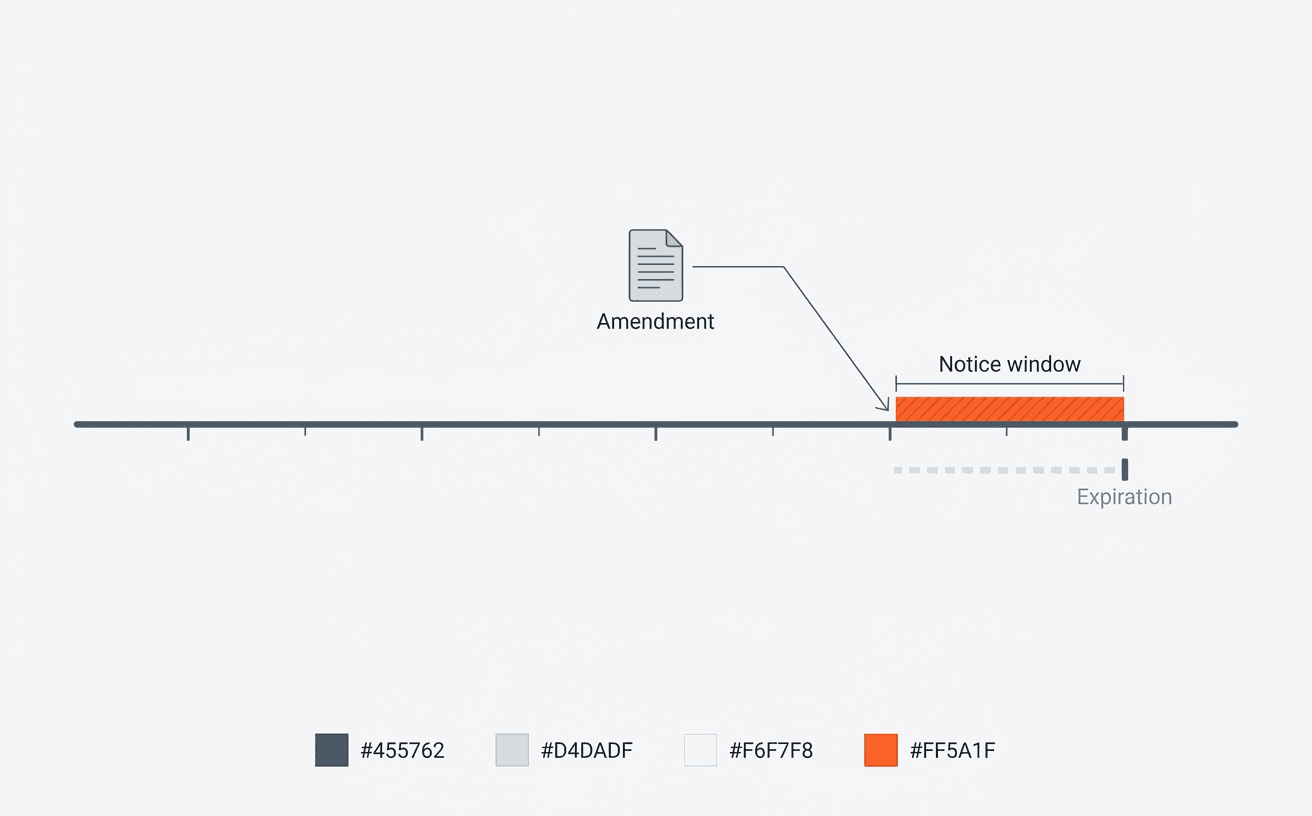
Here is what a date tracker has to handle to be trusted across a portfolio:
| Component | What it involves | Where homegrown tracking slips |
|---|---|---|
| Date extraction | Commencement, expiration, option and notice dates from lease, amendments, side letters | Commencement keyed off a certificate of occupancy or opening date that was never entered |
| Notice window math | "Not less than 180 nor more than 365 days prior", calendar vs business days | Only one bound stored; early notice can be as invalid as late notice |
| Conditions | Not in default, continuous operation, sales thresholds | Conditions never captured, so the reminder fires on a right you cannot exercise |
| Delivery requirements | Certified mail, named addresses, copies to lender or counsel | Addresses change by assignment or amendment and the tracker keeps the old one |
| Amendments | Extensions, relocations, new options | Original dates keep firing; new ones never get entered |
| Ownership | Who gets the alert and who backs them up | Reminders tied to a person who has left |
| Evidence | Proof the notice was sent and received | Lives in someone's inbox |
| Portfolio questions | "Which options expire in the next 120 days?" | Requires a manual pull and a reconciliation |
Why do spreadsheet reminders miss notice windows?
Spreadsheet reminders miss notice windows because they store an outcome rather than the rule that produced it. A cell that says "notice due 3/14/2027" is correct only as long as the expiration date, the clause wording and every later amendment agree with it. When a lease is extended, relocated or assigned, the reminder does not know. When a clause says notice must arrive no earlier than twelve months and no later than nine months before expiration, a single reminder date cannot represent the window. When the right depends on the tenant not being in default, the reminder fires regardless.
Public data on missed critical dates in private portfolios is thin, so a federal example is a useful analogy rather than a benchmark. A 2020 audit by the GSA Office of Inspector General found that as of September 2019, 1,022 of the 8,184 active leases it reviewed (12.5%) were in extension and 68 were in holdover. In a tested sample, the agency missed required milestones on 12 of 16 leases (75 percent). Corporate portfolios run differently, but the mechanism is the same: the dates were known, and the process around them needed to hold.
When does building your own date tracking make sense?
Building is a reasonable choice in a few cases:
- Small portfolio, simple leases. A few dozen leases with plain expiration dates and few options can be tracked in a controlled spreadsheet with a named owner and a backup.
- An IWMS that is already well maintained. If your team abstracts every amendment within days and audits date fields each quarter, adding reminders to what you have may be enough.
- Short remaining horizon. If most leases expire within two years and you are not renewing, the value of a new system is limited.
Outside those cases, homegrown tracking tends to work until the person who built it moves on, and the cost of keeping it current sits after launch. We work through that cost in what it costs to build and run your own AI for real estate operations.
The third path: buy the date engine, run your own review routing
The third path is to buy the date engine and notice drafting, then run the parts that reflect how your company decides on top. Which deadlines need a real estate committee review? Which go to the regional director first? How many days before a window opens should a site-level performance review start? Those are policy choices, and they differ by company.
Ask every vendor who builds that routing. Some expect your team to configure or code it on their platform. With REAL, you define the policy and REAL's engineers build and maintain each workflow on the shared record, through custom workflows. One example: every renewal option within 180 days is routed to a renew, renegotiate or relocate review with the store's occupancy cost attached. For the decision itself, see renewal vs relocation.
What REAL does here
REAL's critical dates agent tracks options, renewals, terminations, rent commencements and co-tenancy notice windows across the portfolio and calculates each window from the clause language. Judged on the standard that matters:
- Action: it drafts the notice letter pre-filled with the party, clause and delivery method, for a person to approve and send.
- Evidence: each date links to the source clause, and an amendment re-baselines the dates automatically.
- Outcome and coverage: every option across the portfolio carries its financial impact, so the team prioritizes by value, and the same record feeds lease accounting, so an exercised option reaches the ASC 842 schedule without a second handoff.
Initial agents go live in two weeks, running in parallel with your current process first. Dates are only as good as the abstraction behind them; see build vs buy for AI lease abstraction.
Build vs buy scorecard for critical date tracking
| Criterion | Build (Excel, Outlook, IWMS fields) | Buy | Buy + run your routing on top |
|---|---|---|---|
| Notice window with both bounds | Manual, often one date | Computed from clause | Computed from clause |
| Conditions and delivery method | Rarely captured | Captured with clause link | Captured, routed your way |
| Amendments re-baseline dates | Manual re-entry | Automatic on new document | Automatic, with your approvals |
| Notice drafting | Template copy and paste | Pre-filled from lease | Pre-filled, your sign-off chain |
| Portfolio questions | Manual pull | On demand | On demand |
| Survives staff turnover | Weak | Strong | Strong |
| Best for | Small, simple portfolios | Large portfolios with options | Large portfolios with defined review policy |
Questions to ask before you decide
- How many renewal, termination and co-tenancy rights sit in our portfolio today, and how many are within 18 months?
- For each one, can we show the clause, both ends of the window and the delivery method?
- How many amendments did we sign last year, and how long until each reached the date tracker?
- Who receives each reminder, and who backs them up?
- Where is proof that last year's notices were sent and received?
- Who builds and maintains our review routing, and how does it change when our policy does?
The expensive lease mistakes are rarely the ones negotiated at the table. They are the dates nobody recalculated after the last amendment. For a structured starting point, REAL publishes a critical dates resource, and a portfolio-wide check of what your system says against what your leases say is covered in the lease-to-system audit.
FAQ
What is a critical date in a commercial lease?
- A critical date is any deadline the lease creates that carries a right or an obligation: rent commencement, expiration, renewal and termination option notice windows, co-tenancy cure periods, kick-out rights and similar. Missing one can forfeit a right or trigger a cost, so critical dates are usually tracked separately from routine rent schedules.
Can I track lease critical dates in Excel?
- Yes, and many teams do for small portfolios. The limits appear with scale: a spreadsheet stores a date rather than the clause rule behind it, does not update when an amendment arrives, and depends on a named person to act. Larger portfolios usually need dates computed from clause language with a clear owner and audit trail.
What happens if you miss a renewal option deadline?
- In many leases the option lapses if notice is not delivered as the lease requires, though outcomes depend on the lease language and the jurisdiction. The occupier may then negotiate a renewal without the option's protected terms, or face holdover rent if it stays past expiration. Consult counsel on any specific missed deadline.
How far in advance should renewal options be tracked?
- Track each option from well before its notice window opens, so there is time for a site performance review, market comparison and approvals. Notice periods vary by lease and are often measured in months, and some set both an earliest and a latest date, so the review should start before the window opens rather than when it closes.
Who builds the review routing if we buy?
- It depends on the vendor, so ask. Some expect your team to configure or code routing on their platform. With REAL, you define the policy, such as which options go to the real estate committee and when the site review starts, and REAL's engineers build and maintain the workflow on the shared record.
More From Our Blog
More
Best lease management software for enterprise tenants
Six platforms compared on the criteria a large occupier actually weighs: abstraction at scale, critical dates, CAM recovery, ASC 842, ERP fit, and deployment.

Reading every lease before the renewal clock runs out
A practical approach to tracking critical dates and obligations across hundreds of leases without a bigger team.

Recovering tenant improvement allowances you already earned
TIA dollars expire quietly. Here is how to find and collect them before the window closes.

Initial agents live in two weeks.
Start with one or two high-value workflows, connect the required data and documents, measure the result, then expand across domains.
- A tailored onboarding for every enterprise.
- Fitted to how you actually work.
- Continuous support as your portfolio evolves.