Build vs buy predictive maintenance software for multi-site occupiers
Last updated:
9 min read

For most multi-site occupiers, the best answer is to buy the foundation and run your own rules on top: buy the work-order cleanup, the asset register and the link from each asset to its site and lease, then set the thresholds and approvals that reflect how you run facilities. The cost of predictive maintenance sits in the data work, not the math. A team that builds its own needs to clean work-order history, map every rooftop unit and walk-in cooler to a site, tie repairs to lease responsibility, and keep it all running for years. Building fits a narrow, well-staffed scope.
The longer answer depends on what "build" means for a facilities organization that already runs a CMMS, a few service contracts per region and a capital plan in a spreadsheet. This guide is part of our series on build vs buy AI agents for corporate real estate.
What does "building" predictive maintenance actually mean?
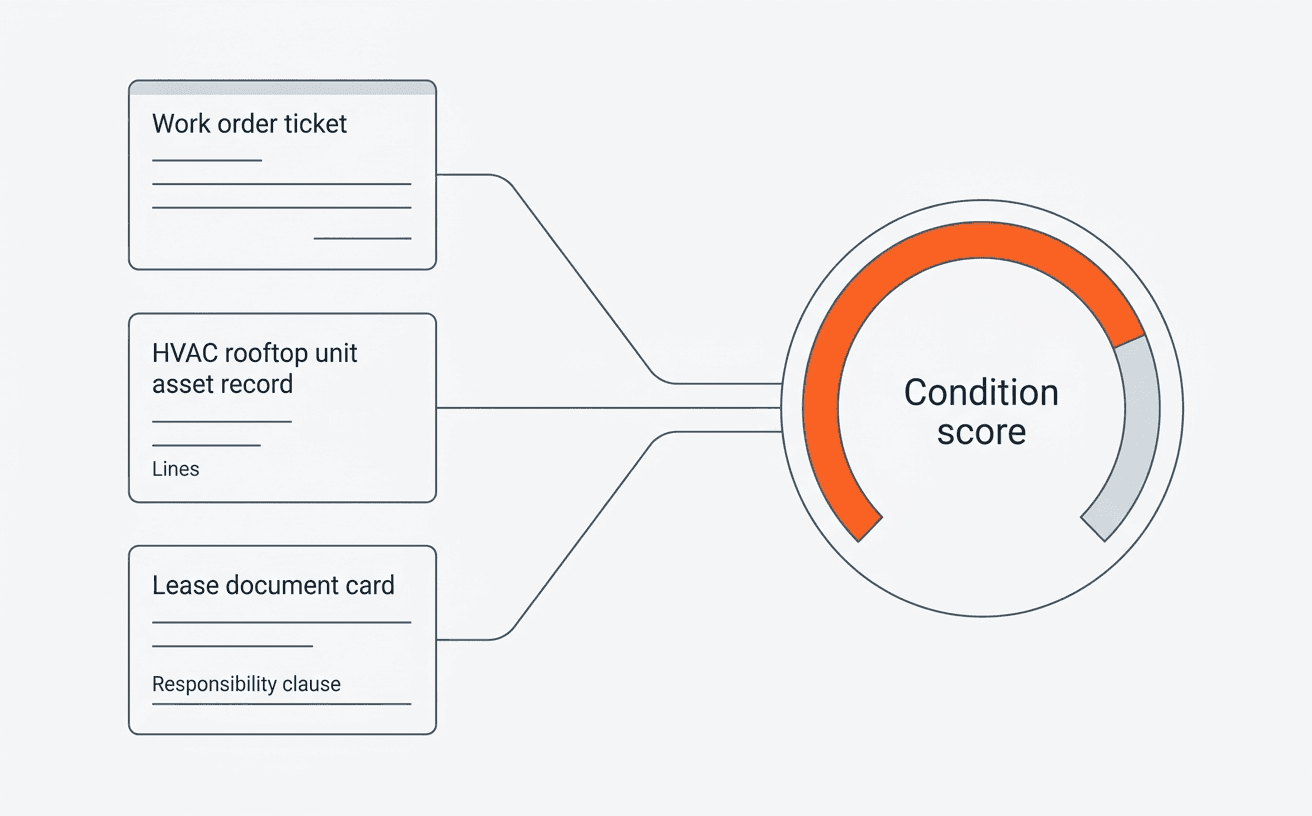
For a multi-site occupier, building predictive maintenance rarely means sensors and vibration analysis on a factory floor. It means an analytics layer on top of the CMMS and the work-order history you already have. The goal is to score each HVAC unit, roof, refrigeration case and generator by likelihood of failure, then decide which ones get preventive work this quarter and which can wait.
That sounds like a model. In practice it is mostly plumbing. Work orders written by hundreds of technicians use free text, inconsistent asset IDs and closing codes that mean different things in different regions. Before any scoring happens, someone has to normalize that history, deduplicate assets that were replaced but never retired in the system, and connect each asset to its site, its warranty and the lease clause that says who pays for the repair. Then the scoring logic needs a home, a review step, and a way to push its output back into the work-order queue.
Here is the inventory a build team takes on:
| Component | What it involves | Who owns it after launch |
|---|---|---|
| Work-order ingestion | Pulling history from the CMMS and service-provider portals, mapping fields across vendors | Data engineering |
| Asset normalization | Matching free-text descriptions to a clean asset register, handling replacements and transfers | Facilities analyst |
| Site and lease linkage | Tying each asset to its location and to the lease clause that assigns repair responsibility | Lease admin plus facilities |
| Condition signals | Equipment age, repair frequency, spend trend, inspection notes, photos, sensor data where it exists | Analytics team |
| Scoring and thresholds | Deciding what score triggers preventive work, and tuning it as outcomes come in | Analytics plus facilities leadership |
| Cost comparison | Estimating act-now versus run-to-failure cost per asset | Facilities finance |
| Work routing | Pushing approved work back into the CMMS with the right vendor and priority | CMMS admin |
| Audit trail | Showing why an asset was flagged, from which records | Analytics team |
| Monitoring and updates | Re-checking scores as equipment, vendors and data sources change | Everyone above, indefinitely |
The last row is the one budgets forget. A model that was right in year one drifts when a region switches HVAC vendors and the closing codes change.
Why it matters: the cost of staying reactive
Moving from reactive to planned work pays, and the gap is well documented. The U.S. Department of Energy's Federal Energy Management Program, in its O&M Best Practices Guide prepared by Pacific Northwest National Laboratory, estimates that a preventive maintenance program saves 12% to 18% on average compared with reactive maintenance, and that predictive maintenance adds an estimated 8% to 12% over preventive. The same guide found that more than 55% of maintenance resources at an average facility were still reactive (DOE FEMP / PNNL, O&M Best Practices Guide, Release 2.0).
The data problem has a price tag too. A NIST study put the cost of inadequate interoperability in U.S. capital facilities at $15.8 billion a year, with owners and operators carrying about two-thirds of it and the operations and maintenance phase accounting for roughly 57% (NIST GCR 04-867). Both sources are older, but the pattern holds: connected asset and work-order data is what lets a facilities team move from reactive to planned work, whoever writes the scoring logic. For the background, see preventive vs predictive maintenance.
When does building predictive maintenance make sense?
Building makes sense in a few specific situations, and it is worth being honest about them.
- The scope is narrow. One asset class (say, rooftop HVAC) in one region, where the goal is to prove that condition-based scheduling beats fixed intervals before committing to a platform.
- The data is already clean. Some organizations have spent years enforcing asset IDs and closing codes in their CMMS. If your work-order history is consistent and your asset register matches what is on the roof, the hardest part is done.
- You have a standing analytics team. People who will own the logic, retune it and answer the controller's questions in year three, beyond a contractor for the pilot.
- The workflow is unusual. A portfolio with specialized equipment (medical gas, pharmacy refrigeration, data rooms) where no vendor's asset library fits.
- It is a one-off study. A capital planning exercise that needs a condition snapshot once, not a living system.
If two or more of these are true, a build can be the right call. If none are, the build usually stalls at the data-cleaning stage, which is where a lot of internal analytics projects quietly end.
The third path: buy the record, run your own rules on top
The third path is to buy the portfolio record and the facilities agents, then run your own rules and workflows on top. The vendor handles ingestion, asset normalization, the link from asset to site to lease, and the audit trail. Your team owns the decisions that are specific to how you run facilities: the score that triggers work, the approval chain, the reporting your CFO wants, the vendor scorecards.
When you evaluate vendors, ask who builds those rules. Some expect your team to build them on their platform, which brings back part of the work you meant to buy out.
Where REAL changes the outcome
A risk score in a dashboard prevents nothing. What matters is the work order it produces, the evidence behind it and the cost result you can measure.
- Action: REAL's preventive maintenance agent reads work orders, service history, equipment age, inspection photos and site records, scores each asset, and sequences preventive work by risk, with the cost of acting now shown against the cost of waiting. It is built to surface a signal 6 to 8 weeks ahead of critical failure where the underlying data supports it.
- Evidence: every flag links back to the records behind it, and each asset is tied to its site and to the lease clause that assigns repair responsibility, so landlord obligations are caught before an invoice is paid.
- Outcome: repair spend, failures avoided and work moved from reactive to planned, measured against your own history. Across existing clients, REAL reports a 4.2% average R&M cost optimization.
On top of the shared record, you define the rules, such as the score that triggers a work order, who approves spend above a threshold, and how vendors are scored, and REAL's engineers build and maintain them as custom workflows.
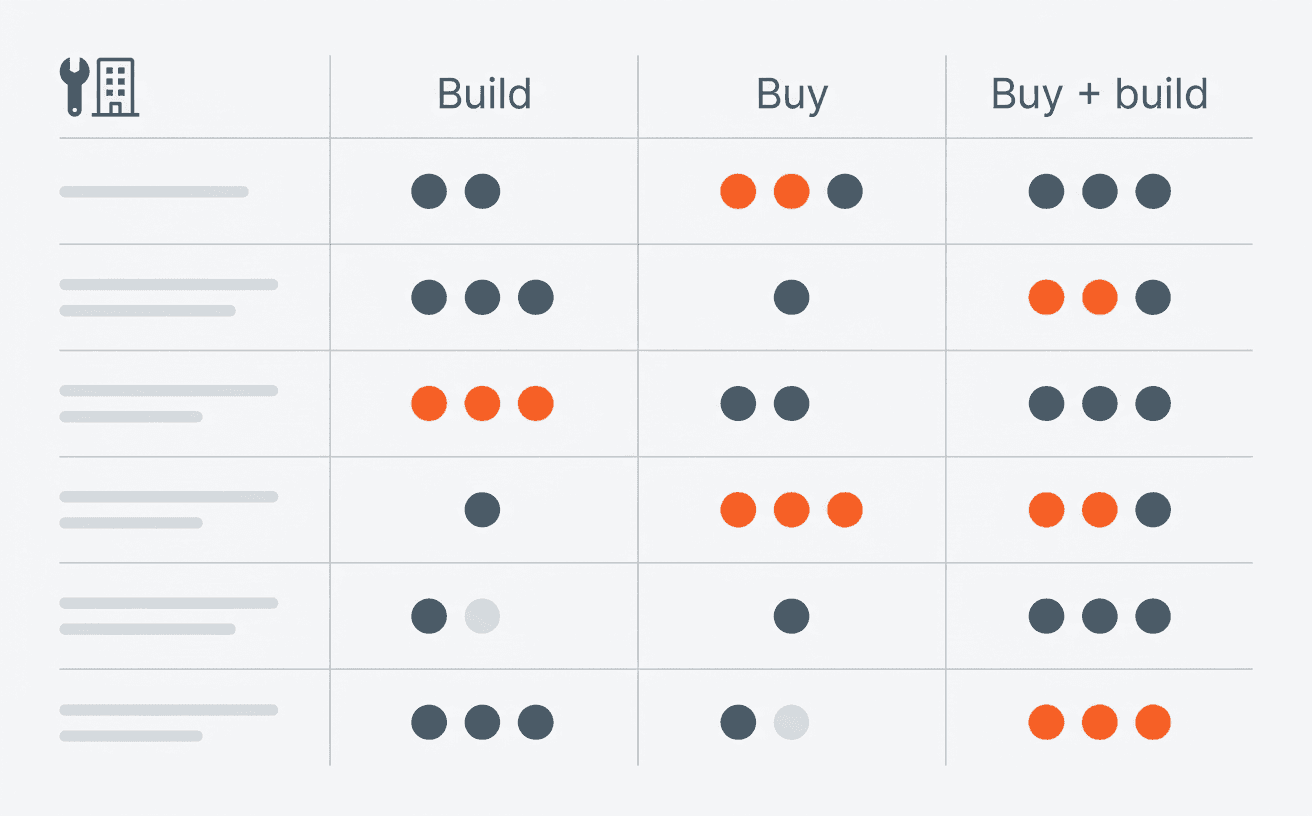
Build, buy, or buy and build on top: a decision scorecard
| Criterion | Build in-house | Buy | Buy + build on top |
|---|---|---|---|
| Time to first useful scores | Months, gated by data cleanup | Weeks | Weeks |
| Work-order and asset normalization | Your team, ongoing | Vendor | Vendor |
| Link to lease repair responsibility | Separate project with lease admin | Depends on vendor scope | Included if the vendor holds the lease record |
| Control over scoring rules | Full | Limited to configuration | Full, on top of vendor data |
| Audit trail for each flag | You design and maintain it | Vendor | Vendor |
| Ongoing maintenance load | High and permanent | Low | Low for the core; your workflows maintained by whoever builds them |
| Fit for unusual asset classes | Strong | Varies | Strong |
| Cost profile | People-heavy, rises over time | Subscription | Subscription plus your workflow definitions |
Questions to ask before you decide
- How many distinct asset IDs exist in the CMMS for the same piece of equipment, and who will reconcile them?
- Can we tell, for any repair, whether the landlord or we should have paid? See work orders at leased sites.
- Who retunes the scoring when a region changes service providers?
- Does the output land in the work-order queue, or in a report someone has to act on?
- What does the capital plan look like if the scores are right? See capital planning with asset lifecycles.
- If the analytics lead leaves, does the system keep working?
To put numbers on the build side, use the cost model for building AI for real estate operations. The decision comes down to where you want your facilities team spending its time: on cleaning work-order history, or on deciding which roofs get replaced this year.
FAQ
Do we need IoT sensors to run predictive maintenance?
- No. Sensors help, but most multi-site occupiers start with what they already have: work-order history, repair spend, equipment age, warranty data and inspection photos. Those signals are enough to rank assets by risk and move a portfolio from fixed-interval to condition-based scheduling. Sensors can be added later for the asset classes where failure is most expensive.
Can predictive maintenance run on top of our existing CMMS?
- Yes, and for most occupiers it should. The CMMS remains the system where technicians open and close work. Predictive maintenance software reads that history, scores assets, and sends recommended work back into the CMMS queue. Replacing the CMMS is a separate decision with a much bigger change-management cost.
How is predictive maintenance different from preventive maintenance?
- Preventive maintenance runs on a fixed schedule, such as servicing every rooftop unit each spring. Predictive maintenance uses condition signals to decide which assets need attention and when. The DOE O&M guide estimates predictive programs save 8% to 12% over preventive ones, mainly by skipping service on equipment that does not need it and catching the units that are about to fail.
What makes predictive maintenance hard at a multi-site portfolio?
- Inconsistent data across sites and vendors. Hundreds of technicians from different service providers describe the same failure in different ways, and assets get replaced without the register being updated. The scoring logic is the easy part. Normalizing the history and keeping it normalized is the work.
More From Our Blog
More
Predictive maintenance for multi-site portfolios: what it actually saves
Predictive maintenance is a budgeting advantage before it is a technology one. Here is what it saves across a leased, multi-site portfolio.

Preventive vs predictive maintenance: which lowers cost across a portfolio?
Preventive bills on a calendar; predictive bills on condition. Here is which lowers cost across a multi-site portfolio, and where each one wins.

The 8 best enterprise asset management software options for multi-site occupiers in 2026
Enterprise asset management software was built for the factory floor. Here are the 8 best options for multi-site occupiers in 2026, ranked.

Initial agents live in two weeks.
Start with one or two high-value workflows, connect the required data and documents, measure the result, then expand across domains.
- A tailored onboarding for every enterprise.
- Fitted to how you actually work.
- Continuous support as your portfolio evolves.