Commercial property tax appeals: build in-house, hire a consultant, or buy software?
Last updated:
8 min read

Should a multi-site occupier build its own commercial property tax appeal capability, hire a consultant, or buy software? For most large portfolios, the answer is a mix: buy software that screens every location and builds the evidence, then run your own routing on top, so each case goes to your team or a consultant by policy. Building the whole operation in-house pays at large scale with dedicated tax staff.
The stakes are real. Businesses paid $390.3 billion in state and local property taxes in FY24, 34% of all state and local taxes paid by businesses and the largest single category, according to the EY study for the Council On State Taxation. For an occupier with hundreds of stores, branches or clinics, property tax is one of the few occupancy costs that changes every year on someone else's assessment. This guide is part of our series on build vs buy AI agents for corporate real estate.
Who actually pays property tax in an occupier portfolio?
Occupiers pay property tax in two ways, and the build vs buy question differs for each. Where the company owns the site, or the lease makes it responsible for paying the bill directly, the tax team deals with the assessor and can appeal. Where the company leases under a triple net or similar structure, the landlord usually receives the bill and passes a share through, often inside the annual reconciliation alongside CAM and insurance.
For leased sites, the question is often "are we being charged correctly?" as much as "should we appeal?" That means checking the pass-through against the lease tax clause: the right parcel, the right pro rata share, base year treatment, caps, special assessments, and whether the lease gives the tenant a right to contest or to require the landlord to contest. A portfolio with mostly leased sites can recover more from pass-through audits than from appeals. See auditing pass-through charges and our glossary entry on the triple net lease.
What are the options, and what does each involve?
There are four realistic setups.
1. In-house tax team (build). Staff track assessments, compare values, file appeals and attend hearings. You keep the knowledge and the data. You also own the coverage work: many taxing jurisdictions, each with its own notice dates, filing windows and evidence rules, and short appeal windows that do not wait for a busy quarter.
2. Contingency consultant. A firm reviews assessments and files appeals, paid as a share of the savings. There is little upfront risk. The trade-off is incentive: consultants rationally prioritize large, high-probability cases. Small-value sites, tax pass-throughs in leases and incentive programs may never be reviewed. The evidence and history often stay with the firm.
3. Software (buy). A tool screens every location's assessment against comparable sites and its own history, flags likely over-assessments, audits tax pass-throughs against lease clauses, and surfaces abatement and incentive programs. It assembles appeal packages. Where a hearing requires a representative, a person still presents the case.
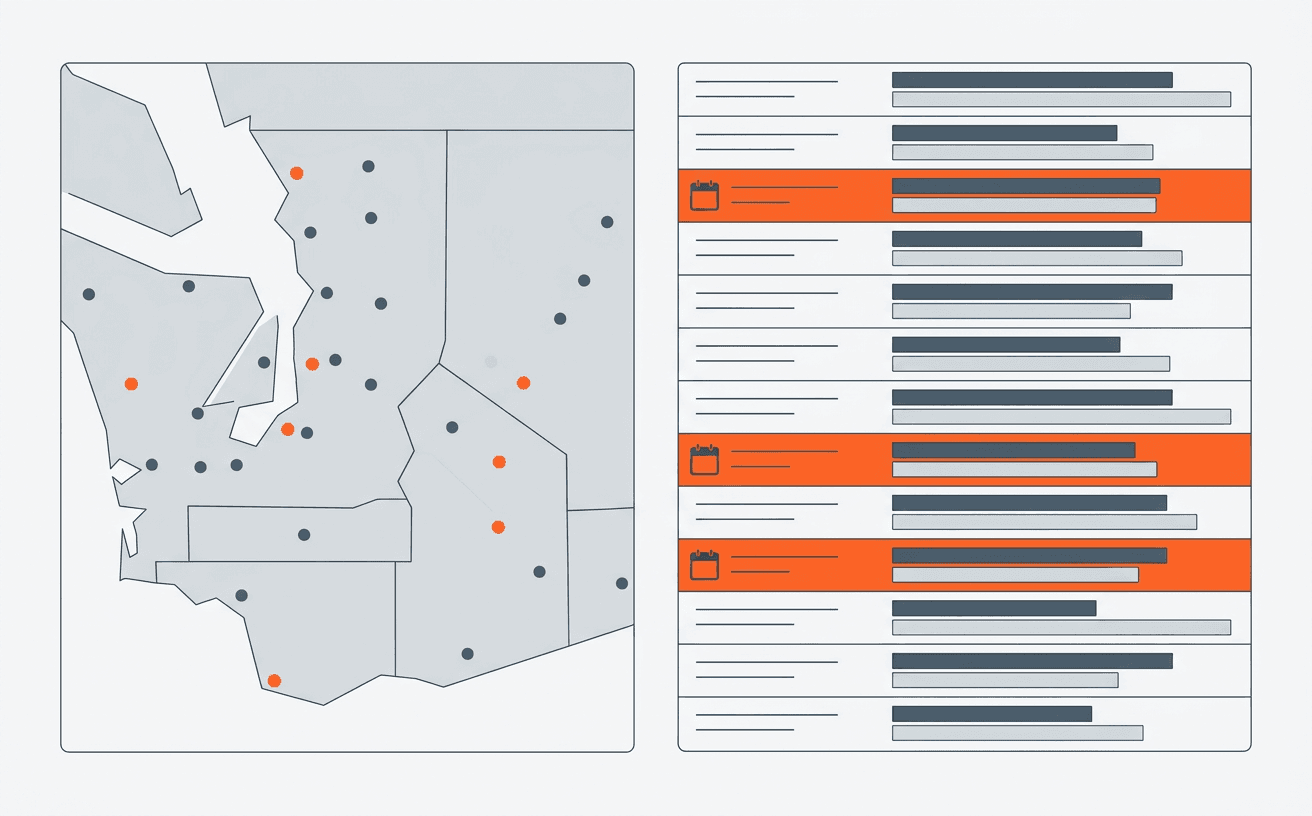
4. Buy the screening, run your own routing (third path). Software covers every location and builds the evidence. Your rules decide which cases go to a consultant, which your team files, and which are not worth pursuing.
| What has to happen | In-house team | Contingency consultant | Software | Buy + your own routing |
|---|---|---|---|---|
| Screen every location every cycle | Hard at scale | Usually the large ones | Yes | Yes |
| Audit lease tax pass-throughs | If time allows | Rarely in scope | Yes, against the lease clause | Yes |
| Find incentive and abatement programs | Ad hoc | Sometimes | Yes | Yes |
| Track jurisdiction deadlines | Manual calendar | Consultant's calendar | Tracked per location | Tracked, routed by your rules |
| Build the appeal package | Staff time | Consultant | Generated, reviewed by you | Generated, routed |
| Represent at hearing | Yes | Yes | No | Your team or consultant |
| Who keeps the evidence | You | Often the consultant | You | You |
| Cost model | Salaries | Share of savings | Subscription | Subscription plus selective fees |
Do commercial property tax appeals work?
Property tax appeals frequently succeed, though results vary widely by jurisdiction and year, and national data is scarce. One detailed public example: the Civic Federation's 2009 report on Cook County appeals found success rates for non-residential appeals at the Assessor ranging from 41% to 62% between 2000 and 2006. That is one county and the data is old, so treat it as an illustration, not a benchmark. The practical point holds: in many jurisdictions a well-documented appeal has a reasonable chance, and the constraint for a large portfolio is finding the right cases across every location before the window closes. Our guide to property tax appeals by jurisdiction covers the local rules.
When does building in-house make sense?
Building an in-house appeal capability makes sense when:
- The company owns much of its real estate and pays tax bills directly across many jurisdictions.
- Volume justifies dedicated staff, enough appeals each cycle to keep specialists busy year-round.
- Geography is concentrated in a handful of jurisdictions the team can know deeply.
- Data already lives in one place, with assessments, bills, lease tax clauses and site attributes connected.
Even then, most in-house teams buy screening data or tools rather than compile comparables by hand. The in-house advantage is judgment and representation, and that is where the team's time pays back most.
What should property tax software do for an occupier?
Property tax software for an occupier should cover both owned and leased sites. It should compare each assessment with comparable locations and the property's own history, audit tax pass-throughs against the lease tax clause and the landlord's reconciliation, identify abatement and incentive programs, and build a jurisdiction-specific appeal package with the evidence attached. For a category view, see commercial property tax appeal software and finding eligible tax programs.
Where REAL changes the outcome
A screening report that sits in a folder recovers nothing. What matters is the action that follows, the evidence behind it and the result you can measure. REAL's tax agent is built to carry the work that far:
- Action: it builds the appeal package for each jurisdiction, and turns a pass-through discrepancy into a recovery claim for lease administration, for a person to approve.
- Evidence: each over-assessment flag cites the comparable locations and the property's own history; each pass-through finding cites the lease tax clause and the line on the landlord's reconciliation.
- Outcome: recovered dollars, filings made before the deadline, and incentive programs applied, measured against last cycle.
The agent also identifies programs such as PILOT agreements, enterprise zones and historic preservation incentives. Because it reads the same portfolio record as the lease and construction agents, a renovation that changes a site's value, or a lease clause that limits tax pass-throughs, is already in context.
The third path sits on top. A typical rule set: appeals above a savings threshold in jurisdictions with formal hearings go to a consultant; mid-size cases in familiar jurisdictions are filed by your team; pass-through discrepancies go to lease administration as a recovery claim. You define those rules, and REAL's engineers build and maintain them as custom workflows on the shared record, so routing follows your thresholds. The consultant relationship improves too: you arrive with the evidence package, the history stays with you, and fees apply to cases that need representation.
If you evaluate other vendors, ask who builds that routing. Some expect your team to build it on their platform, which brings back part of the work you meant to buy out.
Build vs buy scorecard for property tax appeals
| Criterion | Build (in-house team) | Hire (contingency consultant) | Buy (software) | Buy + your own routing |
|---|---|---|---|---|
| Coverage of every location | Low to medium | Medium | High | High |
| Lease pass-through audit | Low | Low | High | High |
| Upfront cost | High | Low | Medium | Medium |
| Cost per recovered dollar | Depends on volume | Share of savings | Falls with scale | Falls with scale |
| Control of evidence and history | High | Low | High | High |
| Hearing representation | Yes | Yes | No | Yes, via routing |
| Best for | Owned, concentrated portfolios | Few high-value sites | Large mixed portfolios | Large mixed portfolios with tax staff |
Questions to ask before you decide
- How many of our locations are owned, and how many pay tax through a lease?
- How many locations were reviewed for over-assessment last cycle, and who decided which ones?
- When did we last audit tax pass-throughs against the lease tax clause?
- Which incentive or abatement programs are we eligible for and not using?
- Who holds our appeal evidence and history today?
- What share of our consultant fees went to cases software could have found?
Property tax is the largest tax businesses pay at the state and local level, and for occupiers much of it arrives as an operating expense inside the lease. The decision is about making sure every location gets looked at, then routing each case to the right person. Related reading: build vs buy for CAM reconciliation and what it costs to build your own AI for real estate operations.
FAQ
Can a tenant appeal property taxes under a triple net lease?
- It depends on the lease and the jurisdiction. Some leases give the tenant a right to contest the assessment, some require the landlord to contest at the tenant's request, and some say nothing. Local rules on who has standing also vary. Start with the lease tax clause and confirm with counsel before filing.
How do contingency property tax consultants charge?
- Contingency consultants are usually paid a percentage of the tax savings they achieve, so there is little upfront cost. Terms vary, so check how savings are measured, whether fees apply to multiple tax years from one appeal, and whether pass-through audits and incentive programs are in scope.
Does property tax software replace a consultant?
- Not entirely. Software can screen every location, audit pass-throughs, find incentive programs and build appeal packages. Where a jurisdiction requires a hearing or formal representation, you still need someone to present the case, either your own tax staff or a consultant.
What documents do you need for a commercial property tax appeal?
- Requirements differ by jurisdiction, but appeals commonly draw on the assessment notice, recent tax bills, comparable property values, income and expense data where relevant, property condition and site attributes, and any recent changes such as renovations or partial closures. For leased sites, the lease tax clause and the landlord's reconciliation are also needed.
More From Our Blog
More
Filing property tax appeals across every jurisdiction
Why assessment review is a portfolio problem, and how to surface the appeals worth filing first.

Finding the tax programs your sites already qualify for
Abatements, PILOTs, and enterprise zones go unclaimed. A way to surface eligibility across the portfolio.
Commercial property tax appeal software: what to evaluate before you buy
Most property tax appeal software manages appeals you already decided to file. The harder job is deciding which assessments to challenge.

Initial agents live in two weeks.
Start with one or two high-value workflows, connect the required data and documents, measure the result, then expand across domains.
- A tailored onboarding for every enterprise.
- Fitted to how you actually work.
- Continuous support as your portfolio evolves.